Monday, April 13, 2009


Easter Sunday – The Resurrection of the Lord
Platform 9 ¾


Readings: Acts 10:34a, 37-43; Psalm 118:1-2, 16-17, 22-23; Colossians 3:1-4 OR 1 Corinthians 5:6b-8; John 20:1-9
Picture: CC Nenyaki

Dear Sisters and brothers, do you know who Harry Potter is? I think most of us are familiar with him – the main character in the popular series of children’s novels written by J.K. Rowling. Today I’m reminded of a scene from the first novel in the series: Harry Potter and the Sorceror’s Stone. As some of you know, the eleven-year-old Harry is actually a wizard. And he is told to go to King’s Cross train station in London to catch the train that is bound for Hogwarts, the school of wizardry, where he will be trained in the magic arts that are his birthright.

But there’s a problem. Harry has been told to board the train at platform 9 ¾. But when he gets to the train station, he finds, of course, that there is no such platform. He stands and stares instead at the brick wall between platform 9 on one side and platform 10 on the other. No platform 9 ¾. What to do? It seems that his journey towards becoming a full-fledged wizard has come to a premature dead-end.

Thankfully, just at that moment, he happens to meet the Weasleys. Mrs. Weasley has come to the station to send off her sons George, Fred and Ron, to Hogwarts. Together, they show Harry how to get onto platform 9 ¾. As it turns out, what you have to do is to run into the brick wall – the dead end – between platforms 9 and 10. Harry follows the example of the Weasley children. And, marvel of marvels, he actually goes through the wall and onto the platform he is looking for. There, he finds the train bound for Hogwarts, which carries him into a whole new world filled with mystery and adventure.

Sisters and brothers, you may think me crazy for suggesting it, but doesn’t Harry’s experience tell us something about this joyous Easter feast that we are celebrating today? For instance, aren’t the people in our gospel today doing just what Harry did at King’s Cross Station? In the gospel, we find Mary, Peter and the beloved disciple running towards a tomb. And what is a tomb but a place for laying lifeless bodies to rest? What is a tomb if not a dead end?

But something happens to the disciples when they get to the tomb. For one thing, they find that the stone that once sealed its entrance has been rolled away. The depressing dead end has been transformed into an exciting entrance into mystery and adventure. The burial cloths have been changed from mere coverings for corpses into signs pointing to new life.

Early yesterday morning I received word that a relative of mine was on his deathbed in a hospital in LA. In a way, as I made the 2-hour long drive south along highway 101, it felt a little like running towards a dead end. And yet, when I got to the hospital and prayed with the family, I couldn’t ignore the unmistakable signs of new life breaking through the hard soil of grief and pain. I couldn’t ignore the strong faith of the wife, who whispered repeatedly into the ears of her unconscious husband, telling him to go into the arms of Jesus. I couldn’t ignore the efforts of the young daughter who, even in the midst of her own sorrow, was bravely trying to help her mom with the arrangements for the funeral that was soon to come. Yesterday, what was to be a drive towards an apparent dead end turned out to be something of a rendezvous with the resurrection.

Still, we need to be honest. These transformations from dead ends to doorways are difficult to discern. When Harry Potter first arrives at King’s Cross Station and approaches a train conductor to find out where platform 9 ¾ is, the conductor says to him, Are you trying to be funny? And, in the gospel, any other people would probably have seen nothing more than an empty tomb. For the mystery of the resurrection is something mysterious, something invisible to the naked eye. As Peter tells his listeners in the first reading, God granted that the risen Christ be visible, not to all the people, but to us, the witnesses chosen by God in advance.

Is God biased then? Why do some people only see an empty tomb, but not the risen Christ? Why are some people able to see only platforms 9 and 10, but not 9 ¾? Perhaps the name of the train station has something to do with it. Seeing the burial cloths at the empty tomb, it is only the disciple whom Jesus loved who saw and believed. Why? Perhaps it is because only someone conscious of being a beloved disciple can appreciate the tomb’s true location under the shadow of the King’s Cross. Isn’t this why we need to take care to look continually beyond the superficial realities of life? Isn’t this why the second reading tells us to think of what is above, not of what is on earth? To be able to locate platform 9 ¾, we need to be less focused only on getting onto the trains on platforms 9 and 10.

And isn’t this what our world is like? Isn’t ours a world that often seems obsessed only with getting onto the twin trains of economic and technical advancement, never mind the cost? Such that many others are left stranded between platforms 9 and 10, facing apparent dead ends, because they have been crowded out of the trains? Isn’t this why some people snap under the pressure? People like 42-year-old Vietnamese immigrant Lin Voong, for example, who went on a shooting spree on April 3 at the American Civic Association in Binghamton, New York, killing 14 people, before turning his gun on himself.

What then are we to do, we who have been entrusted with the secret of platform 9 ¾, we who profess to believe in the mystery of the empty tomb? Are we not called to do what Mrs. Weasley did for Harry Potter, and what we find Peter doing in the first reading today? Are we not called to be witnesses to what we have experienced, to assist others in breaking through the various dead ends of our world, so as to find a place on the train that leads to life? Is this not the very thing that we will be recommitting ourselves to when we renew our baptismal promises shortly? Are we not called to continue to work, each in our own way, towards transforming the global marketplace into a train station located under the shadow of the King’s Cross?

Sisters and brothers, on this joyous occasion of our Lord’s resurrection, where and how might we find platform 9 ¾ today?

A blessed Easter to you all!

Sunday, March 08, 2009


2nd Sunday in Lent (B)
Mountain Preparation


Readings: Genesis 22:1-2, 9, 10-13, 15-18; Psalm 116:10, 15, 16-19; Romans 8:31-34; Mark 9:2-10
Picture: CC southerntabitha

Dear sisters and brothers, don’t you think that we’re really blessed to be living so close to the mountains? It’s so convenient, whenever one has the time and the inclination, simply to drive or even to hike up there. I know someone who likes to do this occasionally, on his days off. Why does he do it? Probably because something wonderful happens to us on the mountain, doesn’t it? Just being on a higher elevation exhilarates us. It feels like a load has been lifted from our shoulders, as though we have left all our cares below. Not only does it leave us feeling more carefree, but the mountaintop also gives us a different perspective on things. At ground zero, amid the many twists and turns of busy city streets, it’s often easy to lose one’s way. Up top, you get a bird’s-eye view of everything. You see more clearly the road you’ve been traveling, and where you need to go. And, of course, the mountain is also the place of inspiration and commitment. Traditionally, it’s the place where people meet and dedicate their lives to God.

And it’s not just literal mountains that bring us such benefits. We can say the same for the various highpoints in our lives as well. Think, for example, of a wedding, or a commencement ceremony, or a priestly or diaconate ordination. Whether or not we are the ones actually graduating or getting married or being ordained, don’t we often find such occasions strangely moving? Like being on a mountain, such highpoints on life’s journey somehow serve to raise us above our many mundane preoccupations. They often give us a fresh perspective on life. They help us to check our bearings. They can even be occasions for renewed inspiration and commitment.

But, as with most things, there’s another side to the story too, isn’t there? While it may be beneficial to visit a mountain from time to time, one doesn’t usually live there. The location is not without its dangers. For, as much as it can inspire, the mountain can also mislead. Although you get a bird’s eye view from up there, you also tend to miss the details. And, as they say, the devil is in the details. I’m reminded of a couple I met after Mass some weeks ago, who were celebrating their 40th wedding anniversary. After I had congratulated them, one of them responded by sharing with me a line she’d come across while shopping for paper napkins: If love is blind, she said, marriage is a real eye-opener! We might say the same for the ordained and religious life too.

Which brings us to our readings on this 2nd Sunday in Lent. As you know, more than simply a time to abstain from meat on Fridays, Lent is traditionally the period for catechumens to prepare to profess, and the baptized to prepare to renew, their baptismal vows at Easter. And our Mass readings have been helping us to do this by leading us to different locations. As you may recall, last week, we were ushered into the desert, to witness and to join in Jesus’ struggle with the devil. Today, we are being taken up to the mountains. And I say mountains, because we are invited to climb not one but two of them – Tabor, the mount of Transfiguration, and Moriah, the summit of Sacrifice.

In the midst of often busy and messy lives at ground zero it’s far too easy to forget the commitment that we made at our baptism. When the going is good, we may tend towards dissolution, just as we may easily get disillusioned when the going is too tough. In the face of such dangers, especially in this Lenten time, our readings offer us an opportunity to regain our bearings, to refresh our perspective, by joining Jesus, along with Peter and James and John, on top of Tabor. But to understand what is happening in this story, we need first to recall its biblical context. In the three gospels where it appears, the Transfiguration is sandwiched between Jesus’ predictions of his own impending death and rising from the dead. Seen against this background, the goal of the Transfiguration becomes clear. It is meant to help prepare and strengthen Jesus, as well as his closest disciples, for the challenges that lie ahead. The uplifting experience on the mountaintop is meant to provide sustenance for the difficult journey on the plain below. Jesus’ glorification is inseparable from his approaching sacrifice, which is the likely subject of his conversation with Moses and Elijah. And it is by following Jesus on his journey even into the jaws of defeat, that the disciples will also come to share in his eventual triumph. This is the profound insight that the Transfiguration offers us. This is my beloved Son. Listen to him.

But the experience proves too much for the disciples, as it often does for us as well. For it is true for us as much as it is for Peter, that at the various highpoints of our lives, we often allow the brilliance of the moment to blind us to its true significance. We may think only of our yearning for glory without considering the need for sacrifice. We may seek only to remain at the top without heeding the call to first descend below. We may think only of ourselves, and those within our immediate circle, without sparing a thought for others further beyond. An occasion like a wedding or a commencement, an ordination or even a baptism, becomes simply an eagerly awaited opportunity to enjoy the excitement of self-promotion, just another experience that we try to prolong and to preserve by taking as many photographs as possible.

Isn’t this why our readings invite us also to accompany Abraham and Isaac on their painful yet determined climb up Moriah? For on this uphill road, as much as at its end, we gain a deeper insight into the significance of Tabor. Here we are reminded that the Transfiguration is more of a path than a destination, that Tabor is really a preparation for Calvary and beyond. Take your son Isaac, your only one, whom you love, and go to the land of Moriah. There you shall offer him up… Don’t these words remind us of another Father and his Son? Don’t they speak to us also of God the Father’s willingness to offer up his only beloved Son, as much as it does Jesus’ obedience to the Father in emptying himself for our sakes? And if it is true of Abraham, that through his obedience all the nations of the earth shall find blessing, isn’t it all the more true of the obedience of Christ?

Sisters and brothers, on this 2nd Sunday in Lent, as we ponder these mysteries on the mountains of Moriah and Tabor, our fervent hope and prayer is that we will find ourselves lifted above the all too narrow and petty concerns that often plague and overwhelm us, that we may find the strength to rise above them, so as to prepare ourselves well to fulfill our baptismal vows by walking before the Lord in the land of the living. For as Paul tells us in the second reading: If God is for us, who can be against us? He who did not spare his own Son but handed him over for us all, how will he not also give us everything else along with him?

Sisters and brothers, what might our time on the mountains teach us today?

Sunday, February 15, 2009


6th Sunday in Ordinary Time (B)
From Quarantine to Compassion


Readings: Leviticus 13:1-2, 44-46; Psalm 32: :1-2, 3-4, 5-6; 1 Corinthians 10: 31-11:1; Mark 1:40-45
Picture: CC scragz

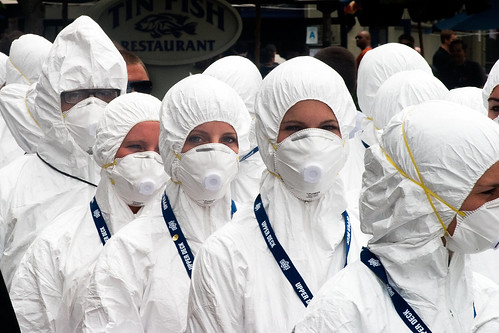
Sisters and brothers, there’s a bug going around town, isn’t there? In my community, three out of the five of us have been feeling under the weather. And wherever I go, whether it’s in school or church, at the cafĂ© or on the street, I seem to encounter more people with coughs and sniffles, at least more than usual. I’ve also noticed my own reaction to all this. I’ve noticed myself becoming more conscious about personal hygiene, more careful about whom I sit next to or shake hands with. I even find myself getting mildly irritated when people forget to cover their mouths and noses when they cough or sneeze. Still, in spite of my irritation, I try not to make too big a deal of it. Even if I do move away just a little when people cough, I try to do it discreetly, without seeming impolite.

But I imagine that my apparent patience is only because the illness is relatively minor. As much as a bad cold will inconvenience me, I know that I’ll probably recover in a couple of weeks. What would my reaction be if the illness were more serious, more highly contagious? What if it was SARs, or a particularly resistant strain of TB, for example? Would I be satisfied with simply practicing good hygiene? Probably not. Faced with such dangers, we tend to step up our precautions, don’t we? We move from hygiene to quarantine. We isolate the sick in order to protect the healthy. We set up boundaries between places that are sterile and those that are infected. We try to shield ourselves by remaining inside and avoiding the outside.

And it’s not just against physical illness that we do this. Don’t we find a somewhat similar move from hygiene to quarantine in international relations? Don’t we boycott or embargo so-called rogue states or dictatorships? And how about when we send crazy people to asylums, and criminals to prison? Or when the poor end up on the streets? And, closer to home, don’t many if not all families have so-called black sheep -- those we prefer to avoid meeting or talking about?

Which is why the practice we find in today’s readings is not so difficult to understand. In the first reading, someone with a sore on the skin is considered a threat to the community, not just medically, but also spiritually, since that person is considered ritually unclean, and needs to be quarantined. Notice the clear demarcation, in the first reading, between the inside and the outside of the camp, and in the gospel, between the town and the deserted places. If the healthy are to be protected, the sick need to be isolated.

As prudent and highly necessary as this practice is, however, it does have dangers of its own, doesn’t it? For one thing, when we isolate those we deem to be sick in one form or another, don’t we run the risk of forgetting about them altogether, of treating them as if they were nonexistent, even of wishing they were dead? Much like one would remove a diseased limb from one’s body, in dealing in this way with those we deem to be diseased, don’t we run the risk of moving beyond quarantine to the more drastic step of amputation?

And this tendency to amputate is something we need to pay close attention to. It is a sign that we are fooling ourselves if we think that we can keep ourselves truly healthy simply by practicing hygiene and quarantine. For this tendency is a symptom of a more deadly disease that infects us all, whether we find ourselves inside or outside. This particular sickness makes our fear and our need for self-preservation run riot, to the extent that we are even willing to sacrifice others to save ourselves. Aren’t the Holocaust and other instances of genocide only among the more extreme examples of the deadly effects of this illness?

Thankfully, however, for some mysterious reason, we never quite succeed in our attempts at doing away with the different and the diseased, the infirm and the inconvenient. Somehow, those we seek to amputate have a way of coming back to haunt us. Isn’t this what we find in today’s gospel, when the leper suddenly shows up where he isn’t supposed to be? Kneeling down, he begs Jesus: If you wish, you can make me clean.

The leper’s actions and his words offer us both a diagnosis and a cure for our disease. If you wish, you can make me clean. Doesn’t this simple straightforward statement powerfully uncover our illness? Isn’t the trouble with us not so much that we can’t make him clean, but that we don’t really want to? And if we really allowed the sight of that wretched specimen of humanity, kneeling in the dusty street, to move our hearts and to haunt our memories, as Jesus so plainly does, will we not also begin to be healed of our own deadly disease, our selfishness and our apathy?

Quite ironically, it is in the leper – in those we may prefer to forget and to isolate, to quarantine and to amputate – that we find the possibility for salvation. But this possibility of a cure only becomes a reality for us if we do what Paul advises in the second reading. We are saved only if we imitate the Lord in seeking the benefit of many, in allowing our fear to be changed into compassion, our passivity into action. And it is precisely this change, this great healing, that Jesus seeks to bring about.

Perhaps this also explains why Jesus insists that the leper should not publicize his cure. For once we think that he has been healed of his disease, can the leper still provide us with a cure for our own? Will he still be capable of moving us to compassion? And perhaps this is also why Jesus ends up exchanging places with the one who can’t keep a secret. In remaining outside in deserted places, Jesus takes on the role of the leper, and becomes the cure for our disease. In order to find Jesus and the healing that he brings, we need to leave the deceptive protection, the artificial isolation, of our towns and our camps. We need to reach out to those living on the fringes, those we might otherwise prefer to ignore and to forget. And, especially with the economy the way it is, it is probably not too difficult for us to find such people today.

Earlier, in our opening prayer, we said that in Jesus Christ God changed humanity’s history by his command of perfect love. Through his life, death and resurrection, Jesus shows us an alternative to our fear-driven strategies of hygiene, quarantine and amputation. He offers us the possibility of writing a different history, a history driven by love and compassion, a history of healing and reconciliation, a history characterized by a reaching out in love to those most in need.

Sisters and brothers, even as many are celebrating St. Valentine this weekend, perhaps it’s appropriate for us to ask ourselves which history it is that we are writing, which disease it is we are resisting today?

Monday, February 09, 2009


5th Sunday in Ordinary Time (B)
Stories Of Loss and Danger


Readings: Job 7:1-4, 6-7; Psalm 147:1-2, 3-4, 5-6; 1 Corinthians 9:16-19, 22-23; Mark 1:29-39
Picture: CC Sir Mervs

Sisters and brothers, today I’m reminded of two stories with which most of you are probably already familiar. The first took place just a couple of weeks ago. It’s the story of the family of seven who died in Wilmington on January 26 – victims of what looked like a murder-suicide. Apparently, the parents had recently been dismissed from their jobs for trying to defraud their employer. And the father then shot and killed his wife and five children, including two sets of twins, before turning the gun on himself.

The second story is older and from further away. It’s the story of the Polish Franciscan priest, St. Maximilian Kolbe. In July 1941, while detained at the Nazi concentration camp in Auschwitz, Fr. Kolbe was starved to death by his captors, after having volunteered to take the place of another prisoner who had been chosen to suffer that very fate.

These two stories are both the same and yet different. They are the same in that both are stories involving loss. In the first, the parents had lost a lucrative means of making a living, and would soon lose their reputations as well. In the second, Kolbe had lost his physical freedom, and much more besides. In both cases, people would also end up losing their very lives as well. But how different are the circumstances. As appalled as we might be at the loss of life in each case, when we hear about the first story, we cannot help but shake our heads at the terrible tragedy of it all. But when we recall the second, something truly marvelous happens within us. We are moved and inspired by what we find.

What does this difference in our reactions tell us if not that there are some losses that are more tragic and more dangerous than others. Worse even than the loss of one’s life is the prospect of losing one’s hope and the sense of one’s own dignity and purpose as a human being. At least arguably, these precious things were lost in the first story, but retained and even advanced in the second.

In our readings today, we also find situations of loss and of danger. We probably all know very well the story of Job. We know how he had lost everything in a series of disasters: his wealth, his property, his family, and even his health. And, in today’s first reading, we find Job in danger of losing something even more precious. My days are swifter than a weaver’s shuttle, he prays, they come to an end without hope… Job is in danger of losing his sense of hope and purpose in life. For what meaning can there be, if a righteous person like him should have to suffer in such terrible ways? Should he follow the advice of his friends and see his trials as God’s punishment for sins he has no knowledge of having committed? Should he simply end his life, as did the Wilmington family in our first story? It is out of this terrible situation of loss and of danger that Job offers his prayer to God.

And isn’t it true that Job’s story is also often our story as well? Even if we consider neither our virtue nor the extent of our difficulties to be quite on par with Job’s, from time to time, don’t we too suffer from losses of one kind or another? And when this happens, don’t we sometimes feel tempted to believe that God is punishing us for sins we may not even be conscious of committing, or thinking that maybe this is due to bad karma? Wondering about the meaning behind it all, don’t we sometimes even find ourselves pushed to the edge of despair? And if, like Job, we were to cry out to God, how might God reply?

The response will, of course, vary from situation to situation, and from person to person. Even so, is there not perhaps some discernible pattern to God’s response? Could this be what we find in today’s gospel? For here too, we are faced with situations of loss and danger. The most obvious of these are to be found, of course, in the people who flock to Jesus. We are told that they brought to him all who were ill or possessed by demons. And he cured many who were sick with various diseases, and he drove out many demons…

Is this then, how God invariably responds to our experiences of loss and danger? If we have a cancerous tumor, does God always take it away? If we are possessed by demons of loneliness or depression, anxiety or despair, does God always ease our pain? If we lose our jobs or our 401(k) investments, does God always immediately reinstate them? While it is true that God often does do such things for us, and while it is highly appropriate and even commendable that we should pray for them if we need to, isn’t it also true that, perhaps just as often, what we pray for doesn’t seem to come to pass? Isn’t this also the situation in the book of Job? In spite of Job’s incessant pleading, for much of the time, God seems to remain painfully silent. What then are we to make of today’s gospel passage?

A clue to an answer is to be found perhaps in what Jesus does at the end of the reading. In spite of a growing demand for his ministry of healing and deliverance, Jesus ultimately decides to leave. Let us go on to the nearby villages, he says, that I may preach there also. What does this tell us if not that, as important as it was for Jesus to cast out demons and to heal, in his mind, it was even more important to preach the good news of the coming of God’s kingdom. And the purpose of his miracles is precisely to proclaim and lead people into this same kingdom. As he tells his disciples: For this purpose have I come.

Here, we find not only a sense of Jesus’ priorities but also the pattern of God’s response to our experiences of loss and danger. If preaching the good news appears more important for Jesus than even healing and casting out demons, isn’t it because, more dangerous even than the loss of one’s wealth and health, is the loss of one’s sense of hope and purpose as a human being? Indeed, isn’t this a danger that Jesus himself faces in the gospel? How tempting it must have been for Jesus to remain where he was well received, and perhaps to set up his own private practice. But, after spending time in prayer, Jesus decides to do otherwise.

Doesn’t his experience show us that one encounters the danger of forgetting one’s purpose as much in seasons of success as in times of suffering? And isn’t this precisely the danger that the good news addresses? Isn’t it in the good news that we find the hope and meaning that we need to face and to overcome the trials that beset us, much as Maximilian Kolbe did at Auschwitz? Isn’t this also the experience of Paul in the second reading, who professes to have made myself a slave to all so as to win over as many as possible…. for the sake of gospel, so that I too may have a share in it?

Sisters and brothers, it’s not a matter of debate that we are now living in a time of loss and of danger. But isn’t it just as much a time of opportunity and obligation, a time when we, the followers of Christ, are especially needed to go out into the global village to preach the good news both in word and action?

How are we being invited to do this today?

Sunday, February 01, 2009


4th Sunday in Ordinary Time (B)
Piercing Problem


Readings: Deuteronomy 18:15-20; Psalm 95:1-2, 6-7, 7-9; 1 Corinthians 7:32-35; Mark 1:21-28
Picture: CC Stuti~

Sisters and brothers, do any of you have ear piercings? I understand that people who do sometimes face a problem. The piercing is, of course, meant for earrings. But, as anyone can imagine, it’s neither comfortable nor convenient to have heavy pieces of jewelry hanging from your ears all the time. On the other hand, however, you don’t want to remove the precious object for too long, because if you do, the hole is likely to close. And then you’ll have to endure the pain of getting your ears re-pierced. So you’re faced with a dilemma. Do you wish to tolerate the hassle of continually wearing a pair of earrings, or do you want to remove them and run the risk of needing to have your ears re-pierced?

Of course, I've heard that these days one can actually buy something called a retainer, which is designed to keep piercings open. But I do remember a time before retainers were readily available. Back then, one of my relatives used to walk around the house with a small piece of a broken toothpick stuck into each of her earlobes – a convenient solution to a difficult dilemma. But I suspect that this tactic is not without risks of its own, one of them being the possibility of infection.

Strange as it may seem, in the spiritual life too, there is a somewhat similar dilemma, a parallel to the piercing problem. We find it, for example, in the experience of the Israelites in the first reading. What is their dilemma? On the one hand, they know that they are nothing without the Lord, their God, who had earlier saved them from slavery in Egypt. Especially through their struggles in the desert, they are beginning to realize that there is something like a piercing within their hearts and in their life together as a people. There is a special space that is meant for God alone to fill. On the other hand, however, they find the experience of God too terribly intense to undergo for any extended period of time. More than any heavy piece of jewelry, the weight of the Divine is so great that when it comes upon them, it feels as if they will perish. So they beg Moses: Let us not again hear the voice of the Lord… lest we die. But then, their piercings keep crying out to be filled. What to do?

As we know, throughout their history in the Old Testament, the Israelites will face continual temptations to fill-in their God-shaped piercings with things that are less than God, things like pagan idols, and greed, and even, as in the case of the Pharisees and scribes of Jesus’ day, the keeping of ever stricter and more detailed prescriptions of the Law. And when this happens, a kind of spiritual infection sets in. When God’s rightful place is usurped, people suffer. The poor are neglected and exploited. The rich lose a sense of their own humanity. Wars and conflicts erupt. The nation itself degenerates in decadence and decay.

It is in the midst of this difficult dilemma then, that Moses announces God’s promise to send a prophet, whose main role is to be something of a retainer. The prophet’s task is to help the people to keep their piercings open for God alone. But for this solution to work, the prophet must speak only what God commands. And the people must heed the prophet’s message. However, we know that frequently, things will not work out as planned. Often, the people will reject and even do away with their God-appointed retainer. Or the prophet will be motivated by self-interest, and end up speaking what is false. In either case, the piercings are once again infected. Suffering and death are the result.

It is into such a situation of spiritual sickness that Jesus enters like a powerful antibiotic. Here at last is the only possible resolution to the dilemma. On the one hand, Jesus is truly God, and so, he is able to occupy the people’s piercings without causing an infection. On the other hand, however, Jesus is also fully human. People can relate to him without suffering the terrible weight of the Divine. As Jesus tells us in another gospel: my yoke is easy and my burden light (Mt. 11:30). It is this resolution to the dilemma that we see in today’s gospel. More effective even than a God-appointed prophet, the divine-human authority of Jesus’s person and teaching are such that they are able to drive out the unclean spirits that contaminate people’s hearts and lives. Quiet! Come out of him! And with a loud cry the unclean spirit is expelled.

Sisters and brothers, isn’t this precisely the kind of authority and healing power that we need so very much especially today – when we seem to be surrounded by difficulties on every side, the financial situation being the most pressing? Plagued by anxieties of every sort, do we not find ourselves sorely tempted to look for quick-fixes of one kind or another, to seek purely practical solutions, relying only on better laws, for example, or more advanced technology, or more accurate information?

These things are, of course, very important. Yet, isn't there also a spiritual dimension to the problem? Could it be that ours is also a spiritual ailment? Could it be that, like the Israelites, ours is also a case of infected piercings? Could it be that we have allowed God’s place to be usurped by unclean spirits of different sorts, greed and self-interest and apathy being among the more obvious? If this is true, then we need to remember that illnesses such as these cannot be effectively treated by simply gathering more and more information. Nor, for that matter, are they cured by merely going to church more often, without a corresponding change in one's attitudes and behavior. As we see in today’s gospel, it is in the synagogue that the possessed person appears. And neither does the unclean spirit lack information. It knows quite well who Jesus is.

Spiritual illnesses require spiritual treatment. The infection of our piercings can only be eradicated when we truly immerse ourselves in the power of Jesus’ teaching and healing action. And isn’t this the reason why we have gathered here this evening? More than merely to satisfy a weekly obligation, we are here so that, in the gathering of God's people and the proclamation of God’s Word, in the breaking of the Lord’s Body and the pouring out of his Blood, our piercings might be purified of every unclean spirit, and God restored to God’s rightful place. We are here, so that, as Paul exhorts the Corinthians to do in the second reading, we too might, once again, commit ourselves to serving the Lord without distraction. Such that when we leave this place to return to our own respective homes, our various occupations and different relationships, we too might become true prophets in the world, God’s retainers, committed to helping to preserve God’s rightful place in the piercings of human hearts and lives.

I'm reminded, for example, of the report in today's LA Times, about the prophetic actions of parish communities in Orange County, who are taking concrete steps to help people suffering under the weight of the current economic crisis.

If today you hear his voice, harden not your hearts…

Sisters and brothers, this is what we prayed in the responsorial psalm just now. How might we better respond to God’s voice as it addresses us today?