Sunday, September 26, 2010


26th Sunday in Ordinary Time
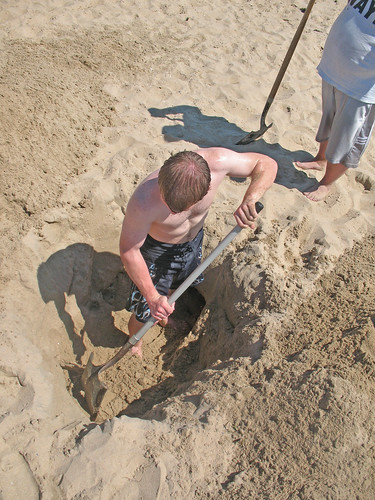
Bridging Gaps or Digging Graves
Picture: cc  The Infamous Gdub
Dear sisters and brothers, when we say that someone has dug his own grave we are usually referring to a person who has been seeking his own benefit but ends up causing himself greater suffering instead. I came across a good example of this on the BBC website yesterday. A man in Akron, Ohio, had been shoplifting in a Walmart. Then, to keep from getting caught, he jumped into a dumpster at the back of the store. Unfortunately for him, a garbage truck happened by just at that moment. Finding himself trapped in the truck, our shoplifter used his cellphone to contact a friend, who then called 911. Eventually, the police managed to get him out, but not before he had undergone considerable suffering. A police spokesperson had this to say about our dumpster diver: (When he was found) he was in a lot of pain. He had been compacted several times. He was just begging us to empty the truck...

The news report does not tell us what the shoplifter’s exact intentions were. But it’s likely that he stole from the store because he was looking for a more comfortable life. He then jumped into the dumpster in search of safety and security. He was trying to escape the police. He did all these things for his own benefit. But he ended up causing himself greater pain and suffering instead. What we have here is a classic case of someone who dug his own grave. Thankfully for him, people heard his cries for help and were able to come to his rescue before it was too late.

The rich man in our gospel parable is not so lucky. After his death, he finds himself trapped and undergoing great suffering. We’re told that he’s tormented by the flames in the netherworld. And, like our shoplifter, he cries out for help. Unfortunately, it’s too late for him. Abraham tells him that a great chasm has been established preventing anyone from rescuing or comforting him even if they wanted to.

And it may be helpful for us to wonder for a moment how this great chasm came to be established. Who put it there? The parable itself doesn’t tell us. And some of us might think that it is God who has done this. It is God who has dug this deep canyon in order to imprison the rich man, in order to punish him for his sins. Perhaps. But could it not also be the case that the rich man is the one responsible? Could it be that, like our shoplifter from Ohio, it is the rich man himself who has somehow dug his own grave?

In order to see this possibility, we need first to consider what the deep chasm does. Notice how it separates people into two groups. On one side, we have Lazarus and those who are comforted. On the other, we have the rich man and those who are tormented. Notice also how this separation that takes place after death corresponds to an earlier division in life -- between the rich and comfortable on one side, and the poor and afflicted on the other. The separation after death is a continuation of an earlier division in life, but with two crucial differences. First there is a reversal of experiences. After death, the one who was comfortable in life -- the rich man -- is now tormented, and the one who was suffering in life -- Lazarus -- is now comforted.

Second, there is also a change in the thing that separates them. It is only after death that their separation becomes final and irreversible. It is only after death that we find the deep chasm, which makes it impossible to cross from one side to the other. In contrast, while in life, although divided, the poor and the rich were actually very close. We’re told that Lazarus used to lie at the door of the rich man’s house. How easy it must have been for the rich man to bridge the distance between him and Lazarus while they were still alive. All the rich man had to do was to open his door to the poor. All he had to do was to show compassion. But he did not do it. Even though he could easily have done so while still alive, the rich man failed to bridge the distance between the rich and the poor. And, after death, it was too late. The rich man had already dug his own grave.

Furthermore, our readings also suggest to us a reason for the rich man’s failure. The rich man neglects to open the door of his house, because he has first closed the doors of his heart. We find an indication of this in the first reading. Here, the prophet Amos pronounces a judgment upon the rich people of his time. Woe to the complacent in Zion! he proclaims. Their only concern is with their own comfort. So focused are they on indulging their own selfish desires, and perhaps in safeguarding their own wealth, that they remain unaffected by the suffering of the masses of poor people who surround them. In the words of the prophet, these rich people are not made ill by the collapse of Joseph. Not unlike our shoplifter from Ohio, in seeking only their own comfort and security, they end up diving into the disgusting dumpster of their own complacency. And isn’t this the same complacency that then results in the great chasm imprisoning the rich man in the netherworld? Notice, for example, how complacent, how arrogant, the rich man remains even after death. Even as he is tormented by hellfire, he continues to order people about. He wants Abraham to send Lazarus first to cool his tongue and then to warn his brothers. As in life, so too in death. The rich man continues to treat the poor person -- if he notices him at all -- as nothing more than a slave. Isn’t it clear then who is the one responsible for the chasm separating him from the joys of heaven. By his own complacency, the rich man has dug his own grave.

All of which should lead us to reflect upon our own situations. Perhaps some of us might consider ourselves rich. Others might consider ourselves poor. But whether rich or poor, by virtue of our baptism, all of us here are called to be what the second reading tells us that Timothy was called to be: men and women of God, called to keep Christ’s great commandment of love, committed to rejecting complacency, so as to show compassion, determined to do what we can in this life to bridge the gap between the rich and the poor.

And it is important to keep this calling of ours constantly in mind, especially as we approach this country’s midterm elections in November. During this time, when the citizens among us are being called to make crucial decisions as to who we want to represent us in government, when various candidates are campaigning for our vote, perhaps our readings today suggest to us a crucial question that we need to consider before casting our ballots: Is this candidate doing something to bridge the gap between the rich and the poor? Or is s/he only continuing to help us dig our own graves?

And what about each of us, sisters and brothers? In our daily lives, are we bridging gaps or digging graves? How might each of us answer this question today?

Sunday, September 19, 2010


Sacrament of Holy Matrimony
Patrick Moyer and Rachel McCarthy
The Secret of Setting Up Shop
Picture: cc ralph and jenny

My dear friends, have you ever been to the opening of a new store? What was it like? I remember when the Apple Store opened some months ago on State Street in Downtown Santa Barbara. It was such a grand and joyous affair. The line of people waiting to get in stretched almost halfway around the block. But beneath all the fun and excitement, I imagine that much serious thought was also put into ensuring the store’s success. Which is important especially in the current economic climate where, as you probably know, at least on State Street, the turnover rate is particularly high. Many stores don’t survive beyond a few months. But then, there are also others that seem to thrive. I know of a sushi restaurant, for example, that opens only for dinner, but is always filled to the rafters. So what is the secret? What are some of the things that help to ensure a store’s success?

I’m not a business person. But I imagine that at least three things are crucial. The first is, of course, location. As far as possible, you want to situate your store at a place that’s conducive for the particular kind of business that you’re operating, a location that’s convenient for both your suppliers and your customers. But that’s not all. A store’s success will also depend upon the product or service that it provides. It’s got to be something that people need or want. For example, there are no less than six coffeeshops on Downtown State Street. And, as far as I can tell, all of them are doing well. Why? I guess, everyone gets thirsty. Finally, of course, in addition to location and service, one must also have access to the necessary capital to get the store set up and to keep it running. A successful business doesn’t usually flourish without continuous careful attention. It requires a considerable investment of resources, both financial and otherwise.

Dear friends, today we are, of course, not gathered here for a store opening. But we are celebrating the union of Pat and Rachel in Holy Matrimony. We’re here to support Pat and Rachel in their new undertaking. We’re here to share their joy as they set up shop as husband and wife. And, as with any store opening, together with Pat and Rachel, we do well to consider some of the crucial ingredients for success. Especially at a time when the turnover rate for marriages seems particularly high, we need to give serious thought to location, service and investment.

Consider first the location to which Pat and Rachel have invited us. In choosing to be married in church, Pat and Rachel are doing more than simply giving us an excuse to gather in this beautiful building. In choosing a church wedding, they signal to us their determination to situate their life together in a very particular spiritual location. We find the shape of this spiritual location described in the scripture readings that Pat and Rachel have chosen for this joyous occasion.

In the gospel, Jesus speaks about the nature of the union between a husband and a wife by referring to what God intended at the beginning of creation. Jesus alludes to the creation story in the book of Genesis, where God’s plan was not just to bring a man and a woman together, but also to give them a happy and harmonious life in the Garden of Eden, a place in which every created thing exists in right relationship -- the man with the woman, humanity with the environment, all of creation with its Creator.

And if the gospel reminds us of the harmony that characterized the beginning of creation, the second reading speaks of the how this harmony eventually comes to its fulfillment at the end of time. The image offered to us is that of the marriage between the Lamb and his bride the Church, the union between Christ and God’s chosen people.

It is between these two unions -- one at the beginning of creation, and the other at the end of time -- that Pat and Rachel have chosen to situate their own coming together as husband and wife. And this choice of location also indicates to us the service that they wish to offer to us and to all the world. In a society polarized by various apparently opposing ideologies, in a world torn by conflict and division, through their commitment of love for each other, Pat and Rachel are bearing witness to the possibility of lives lived in harmony and right relationship, in unity and peace.

But this happy state of affairs does not come about without a willingness to make a substantial investment. As we heard in the first reading, a husband is happy when he is blessed with the gift of a good and virtuous wife, a partner willing to invest herself completely in their life together. And what is said of the husband is, of course, equally applicable to that of the wife. Her happiness is linked to the willingness of her husband to invest himself totally in their life together. Still, as those among us who are already married probably know well, this kind of investment is not easy to make. It’s especially difficult once the euphoria of the honeymoon is past. When a couple is faced with the ordinary challenges of daily routine, when one might discover, for example, that one’s partner is determined to squeeze the toothpaste from the middle of the tube instead of from the end, or that the other has an allergy to doing the dishes or taking out the trash, it becomes so much more difficult to remain totally invested.

Which is why the location chosen by Pat and Rachel for their marriage is such a wise and prudent one. For by making this choice, they demonstrate their awareness that their ability and willingness to invest fully in their relationship does not come ultimately from them. As our second reading tells us, the linen dress worn by the bride of the Lamb, which symbolizes the virtuous deeds of God’s saints, is itself a gift from her spouse. The bride’s virtue is a gift that was paid for by the Lamb, when he gave his life for his spouse, when he shed his last drop of blood for her on the Cross. In choosing to celebrate their union in church, in choosing this particular spiritual location for the beginning of their life together, Pat and Rachel are expressing their determination to rely upon the prior investment of Christ in the life of his Church. And we who are witnesses to their commitment, in turn, commit ourselves to giving them our continual support and encouragement.

Dear friends, you have all probably heard that well known phrase that goes: a wedding is for a day, but a marriage is for a lifetime. In the days ahead, together with Pat and Rachel, how might each of us remain attentive to location, service and investment in the shophouse of the Lord?

Sunday, September 05, 2010


23rd Sunday in Ordinary Time (C)
Worth Playing For?

Readings: Wisdom 9:13-18b; Psalm 90:3-4, 5-6, 12-13, 14-17; Philemon 9-10, 12-17; Luke 14:25-33
Picture: cc CBS


Dear sisters and brothers, have you ever watched Survivor? Those who have will know that in this reality TV game show a bunch of people allow themselves to be stranded for more than a month at some remote location. They willingly say goodbye to family and friends, and are left to fend for themselves, with little more than the clothes on their backs. Not only do they have to construct their own shelters, and catch and cook their own food, they also have to compete with one another in physically and mentally demanding challenges in an effort to keep from getting voted off the show. In the words of the show’s tagline, they have to outwit, outplay and outlast one another. It’s not a game for wimps. As the days go by, and more and more of them get voted off, the remaining participants grow visibly thinner and thinner for lack of nourishment. Some get sick or injured. Others break down emotionally. And all of this on national television.

Even so, despite the difficult conditions, there seems to be no shortage of people willing to play. As you know, the show’s 21st season – Survivor: Nicaragua – will begin airing in a couple of weeks. Why do people do it? The reason is obvious enough. Not only do they stand a chance of winning a million dollars, they also attain instant celebrity status. All their suffering is not for nothing. Which is also something that the show’s host, Jeff Probst, continually reminds the participants. At the start of each challenge, after having shown the players what they stand to win, Jeff always asks them the same question in three words: worth playing for? Is this worth renouncing the companionship of family and friends for? Is this worth being exposed to the elements and suffering malnourishment for? Most of the time, the survivors’ answer is yes. Yes, of course it’s worth playing for!

Like the survivors, it would appear that we Christians also need continually to ask ourselves a similar question. For the spiritual life is not any less demanding than the game show. As Jesus, our host in today’s gospel reading, tells us: anyone who does not hate family and friends, and even his own life, anyone who does not carry his own cross and come after me cannot be my disciple. The demand is clear and uncompromising. The word hate is used to emphasize that in all situations, the Christian must act in such a way as to place the Lord first, above even family and self. This, of course, is not an easy thing to do. Which is why, Jesus insists that those of us who wish to follow him need to examine our commitment. Like the survivors, we need continually to ask ourselves: Is it worth playing for?

But, in order to answer this question, we need to reflect more deeply upon the game we are playing, upon what exactly it is we are being asked to sacrifice, and for what reason. Notice, for example, how Jesus concludes his speech in today’s gospel with a call to renunciation. Anyone of you who does not renounce all his possessions cannot be my disciple. With this statement, Jesus helps us to understand what it means for a Christian to hate family and friends, and even one’s own life. Could it be that what we are being called to hate, what we are being called to renounce, is our tendency to see and treat everything and everybody in our lives as possessions, as things that we can use purely to further our own selfish interests? When spouses take one another for granted, for example. Or when parents ignore their children’s dreams but pressure them to fulfill the parents’ own desires. Or when siblings fight over their inheritance. In such situations, aren’t people relating to one another purely in terms of possessions?

Also, we may do well to remember that even when we might have a legitimate right of ownership over something, that right does not entitle us to use that thing without regard to the interests of others. Although the Church recognizes the individual’s right to private property, she also tells us that this right does not do away with the original gift of the earth to the whole of humanity. The Catechism of the Catholic Church reminds us that in our use of things we should regard the external goods we legitimately own not merely as exclusive to ourselves but common to others also, in the sense that they can benefit others as well as ourselves (CCC 2403-4).

Our readings today invite us to reflect upon what happens when we relate to things and people purely as possessions. When we do this, everything and everyone in our lives become obstacles preventing us from knowing and fulfilling God’s plan for us. As the first reading tells us: the corruptible body burdens the soul and the earthen shelter weighs down the mind that has many concerns, such that we are unable to conceive what the Lord intends. In order to seek and to fulfill God’s will, we must first be willing to renounce our possessions, so that the holy spirit from on high can transform these obstacles into pathways to God.

This is precisely what Paul is asking his friend Philemon to do in the second reading. Writing from prison, Paul asks Philemon to renounce his right of ownership over the slave Onesimus, whom Paul had earlier converted to Christianity. According to Paul, if Philemon is willing to do this, Philemon’s relationship with Onesimus will be transformed. Paul writes: Perhaps that is why he was taken away from you for a while, that you might have him back forever, no longer as a slave but… a brother... in the Lord. What Paul is asking Philemon to do is to renounce a possession in order to gain a relative. By giving up his claim over Onesimus, Philemon would be fulfilling God’s plan. He would be allowing the Holy Spirit to transform the obstacle of slavery into a pathway of love in the Lord. For this to happen much depends upon whether or not Philemon is free enough to say yes. Much depends upon how he answers the question: Is this new relationship in the Lord worth playing for?

It thus becomes clear, sisters and brothers, that what is at stake, what we Christians are playing for, are the very things that we prayed for earlier in our opening prayer. You will recall that we asked God our Father to give us true freedom and to bring us to the inheritance you promised, the inheritance that is the Kingdom of God that Jesus came to proclaim, the Kingdom in which all bonds of possessiveness and domination will have been transformed into relationships of love in the Lord. In this Kingdom, people will no longer be forced to work as undocumented aliens in a foreign land, under unsafe and unhealthy conditions, for less than a living wage. In this Kingdom, the environment will no longer be polluted for the sake of economic advancement. In this Kingdom, the love and peace of God will prevail over all.

Sisters and brothers, there are many people who are willing to endure considerable suffering just for the sake of winning a million dollars – before taxes – and the title of Sole Survivor. Can we who claim to be followers of Christ do any less, especially when what’s at stake is the very Kingdom of God?

Sisters and brothers, what do you think? Is this worth playing for today?

Sunday, August 29, 2010


22nd Sunday in Ordinary Time (C)
Oh Lord It’s Hard to Be Humble…


Dear sisters and brothers, as sometimes happens, our readings today remind me of a song. It’s an old country number by Mac Davis. And the chorus goes like this:

Oh Lord it’s hard to be humble when you’re perfect in every way. I can’t wait to look in the mirror ‘cause I get better looking each day. To know me is to love me. I must be a hell of a man. Oh Lord it’s hard to be humble but I’m doing the best that I can.

Don’t be mistaken, sisters and brothers. Of course I know that I’m far from perfect in every way. And I’m definitely not getting better looking each day. But, even with all my flaws, I have to agree with Mac Davis that it is truly hard to be humble. Don’t you think so?

For one thing, it’s difficult to know what exactly it means to be humble. What at first looks like humility can often turn out to be something very different. For example, if I am unable to accept a genuine compliment because I don’t think very highly of myself, that’s not humility. It’s just low self-esteem. And neither is it true humility either, if I criticize myself on purpose, just so I can hear others disagree and tell me how wonderful I am. Humility is not a hook that I can use to fish for flattery. Humility is not about falsehood. It’s about the truth.

Even so, our readings remind us that humility has to do with lowering ourselves in some way. Humility involves lowering ourselves by first recognizing that all the good things in our lives are blessings from a generous and loving God. As the first reading reminds us: humble yourselves the more, the greater you are, and you will find favor with God. And not only does humility involve lowering ourselves before God, it also involves lowering ourselves before others. As Jesus tells his listeners in the gospel today, to be humble means to be willing to take the lowest place. And this is far from an easy thing to do, especially today, when it often seems that our very survival depends on our being able and willing to fight tooth and nail for the highest places. And what does it mean for me to take the lowest place if I am already unemployed, with a family to feed? Does it mean that I should somehow do less than my best to secure a job?

Which leads us to a second reason why I think it’s hard to be humble. It’s hard not just to know what humility is. It’s also hard to figure out when exactly to be humble. It’s difficult to know when we should lower ourselves before others. Consider, for example, what Jesus does in the gospel. Notice how several verses are missing from our reading, which jumps from verse 1 to verse 7. In verses 2 to 6, a man appears who has a sickness called dropsy. And Jesus challenges those with him at table: Should he heal this man even though it is a Sabbath day? Everybody keeps silent, probably because they think that it is unlawful to do so. Still, Jesus heals the man and sends him on his way. Was Jesus being humble? Was he lowering himself? Not before the Pharisees he wasn’t. But Jesus stood up to the Pharisees only so that he could lower himself before the one who needed healing. He challenged the first in order to show compassion to the second. And by doing this, Jesus teaches us that there is a right time and a wrong time to lower ourselves. The difficulty lies in distinguishing one from the other.

And, in order to do this, in order to know when is the right time to lower ourselves, it is important for us to face a third difficulty. Not only must we consider what humility means and when we should be humble, we also have to ask ourselves why we need to be humble. Why should we even bother to lower ourselves before others? Why not just rush for the highest places like everybody else?

It may at first appear that our readings are proposing a purely practical answer to this question. Why should we lower ourselves before God? According to the first reading, it is so that God will show us favor. And why should we take the lowest place before people? According to the gospel parable, it appears that it is only so that we can then be raised to the place of honor. But is this true humility? Or does it not resemble the kind of tactic used by the person who criticizes himself in order to fish for compliments from others? Consider also what Jesus tells us in the second half of today’s gospel. When we hold a lunch or dinner, we are to invite those who cannot invite us back – the poor, the crippled, the lame, the blind? Why? According to Jesus, we will be repaid at the resurrection. But is this the only reason why we should invite all these people? Just so that we can be repaid? Is there no other reason to be humble, no other reason to lower ourselves?

Our readings contain a deeper reason. Notice, for example, what we heard in our second reading. Here, the writer invites us to compare two different appearances of God. The first is God’s appearance to the Israelites on Mount Sinai. The second is to us on Mount Zion. In both cases God lowers God’s self in order to show mercy to the people. But notice how the second lowering far exceeds the first. In the first, God spoke in a voice that still frightened the people, such that they begged that no message be further addressed to them. Then, in the second, God speaks in a different, far more accessible, far more approachable voice. God addresses us in the blood of Christ the Son, which speaks more eloquently even than the blood of Abel. This is the same blood of which we will partake at this Eucharist, the blood that sings of a love more powerful even than death. What then do we find here in this reading, sisters and brothers, if not a moving description of a humble God? One who is willing to lower God’s self even to the extent of shedding blood upon a Cross. And the reason why God does this is to raise us up. In the words of the response to the psalm: by lowering God’s self, God has made a home for the poor. Here, sisters and brothers, we find the deeper answer to our question. Why should we be humble? Why should we lower ourselves? We do so for no reason other than that this is what our God has done and continues to do for us. Like children who love nothing better than to imitate their parents, we are called to humility because we are sons and daughters of a humble God.

Sisters and brothers, it is indeed hard to be humble. But are we truly doing the best that we can?

Sunday, August 22, 2010

21st Sunday in Ordinary Time (C)
Who Made You?

Picture: cc Virginia Zuluaga


Dear sisters and brothers, have you ever seen people shopping for designer goods – say, maybe a Ferragamo bag or a Coach wallet, something like that. Maybe you even buy such things yourself. They’re very costly, aren’t they? And not only are they costly, but these days fakes are also very common. And I don’t mean an obvious imitation. Like a bag that says FerraBamo, for example. These days, fakes can look very authentic. So how do you know that you’re getting your money’s worth? How do you make sure that what you’re buying is the real deal?

A good way is, of course, to buy directly from the designer store. But then there are those of us who don’t want to pay the full price. So we go elsewhere, looking for bargains. And that’s when you have to be especially careful. What do you do? You check the product very carefully. You examine the zipper, for example, and the rest of the material. You make sure that the item bears all the marks of the designer. What are you really doing? Whether consciously or not, when you give the product the once over like this, you’re really questioning it, aren’t you? Where do you come from? You ask. Who made you? And you will only buy the thing if the answer is Ferragamo and not Ferradamo.

We find something similar in today’s gospel. Here, Jesus tells a parable about people trying to gain entrance into the kingdom of God. Unfortunately, not everyone is admitted. Not unlike a shrewd buyer of designer goods, Jesus chooses only a certain kind of people to enter the kingdom. Like goods that are guaranteed by a designer store, the people the Lord chooses are those who enter through the narrow gate. And when others try to get in after the gate has been closed, he tells them something very interesting. I do not know where you are from, he says. Even when these people tell him that they’ve spent much time in his company, even though they claim to have listened to him teach in their streets, Jesus says he doesn’t know where they are from. It’s as though, like the shopper looking at a fake product, after giving them the once over, the Lord turns them away because he does not recognize in them any mark of the designer. He doesn’t know who made them.

Some of us may still remember the old Catechism, which presented its lessons in question-and-answer format. Who made you? was the first question. To which the answer was God made me. This is our belief as Christians: that, even though our parents gave us birth, we owe our existence ultimately to God. Who made you? God made me. And yet, isn’t it also true that our birth is but the beginning of a much longer manufacturing process? Although God may have been the one ultimately responsible for putting us on this earth, through the choices we make, we somehow play a part in shaping our own lives. As someone once said: what we are is God’s gift to us. What we become is our gift to God.

But this doesn’t mean that we can do whatever we like. Like designer goods, our lives will be of a certain quality only if they are shaped according to the designer’s directions, only if they bear the mark of the Lord. Isn’t this the problem with the people in Jesus’ parable? Instead of following the Lord by entering through the narrow gate, they have led lives according to their own design, such that the Lord does not recognize his mark on them. He does not know where they are from, who it is that made them.

But how does one enter through the narrow gate? How does one follow the designer’s directions? If it isn’t enough just to go to church every Sunday, what more is required of us? We get some hints of an answer from the rest of our readings.

In the first reading, for example, we find God sending out people to gather the nations into God’s kingdom. And these people who are sent are told to do one thing. They are to proclaim the Lord’s glory especially to those who have never heard of the Lord’s fame. Or, in the words of the response to the psalm, they are to go out to all the world and tell the Good News. Although this may seem like what the people in the gospel claim to have been doing, there is an important difference. It’s possible to spend time with Jesus and even to listen to his teaching only for the sake of our own selfish interests. I may go to church only because my girlfriend goes too, or only because there is something I need the Lord to do for me. I may preach the Word so that people may think highly of me. I can do all these things for my own glory. But what the people in the first reading are sent to do is to proclaim God’s glory, not their own. To allow ourselves to be shaped by God, we need somehow to make the praise of God the center of our lives, as Jesus did. And you can only really praise someone if you have experienced the person’s goodness. Authentic praise can spring, for example, out of gratitude – gratitude for all the good things that God has done, and continues to do for us, gratitude especially for the love that God has shown us in Jesus Christ our Lord.

And yet, life is not just filled with bright moments. It is also sometimes covered in shadow. Can we continue to be grateful, can we continue to praise God at such times? According to the second reading, the answer is yes. Even in times of trial, it is possible to continue giving glory to God if we learn to see such difficult times as moments of discipline. It’s difficult for us to do this because we often connect discipline with punishment. When something bad happens, we may immediately ask ourselves, Why? What have I done wrong? Why is God punishing me? But discipline does not have to be the result of guilt. Athletes in training discipline themselves even though they may have done nothing wrong. The point of the second reading is that it is possible to praise God in dark times, when we learn to see our trials as opportunities for growth in the ways of God. This is how we enter through the narrow gate as Jesus did. Both in good times and in bad, it is possible for us to allow God to shape us. Through praise and through discipline, it is possible for us to come to bear the mark of the Divine Designer: neither the brand of Coach nor of Ferragamo, but the mark of the Cross of Christ.

And we do this even more effectively when we allow praise and discipline to meet, when, in our gratitude for all the good things that God has done for us, we praise God by reaching out to help those who may be experiencing God’s discipline. Isn’t this especially important in these days when massive flooding has displaced thousands in Pakistan, even as, here at home, many others continue to suffer the effects of unemployment and homelessness.

Sisters and brothers, when we examine our own lives on this 21st Sunday in Ordinary Time, whose mark do we see? Who is making us, today?