Sunday, April 08, 2012


Easter Sunday
Beyond the Bright Side

Readings: Acts 10:34,37-43; Psalm 117:1-2,16-17,22-23; Colossians 3:1-4; John 20:1-9
Picture: cc Caitlinator

Sisters and brothers, what kind of people do you think our world needs most today? This planet of ours, which so often seems engulfed in darkness. What kind of people do you think it needs most of all? The answer appears quite straightforward, doesn’t it? In a world of shadows, what more can we need than people able to see the brighter side of life? Optimistic people. People who think only positive thoughts, who speak only cheerful words. Isn’t this why the coach of the national women’s table-tennis team provoked such a strong reaction recently, when he predicted that Singapore had only a 1% chance of beating China in the world championships? People got angry with him. Never mind if what he said was true. He shouldn’t have said it.  He was being defeatist. He should have spoken more positively. He should have looked on the bright side.

I’m reminded of a story of a father who had twin sons. The two little boys were identical in appearance, but very different in temperament. As different as night and day. The first boy was a pessimist. His brother an optimist. One day, the father decided to put them both to the test. He filled the room of the first boy–the pessimist–with all the latest toys and gadgets that he knew the boy liked. And the other son’s room he loaded with horse manure. As expected, when the father later visited his pessimist son in his room, he found him sunk deep in depression. What am I going to do with all these toys? The boy asked, shaking his head. Now all my friends will get jealous of me. I’ll have to waste time studying all the manuals. I’ll have to spend money on batteries. What am I going to do? In contrast, the other boy was seen, in front of his dung-filled room, jumping for joy. When asked why he was so happy, he replied, pointing enthusiastically into his room, with a big smile on his face, I just know there must be a pony in there somewhere!

If made to choose between the attitudes of these two boys, perhaps we may think that optimism is the better option. After all, better to be happy than depressed, right? But then, whether happy or depressed, isn’t it the case that neither boy was really in touch with the truth? After all, toys may indeed bring difficulties, but also many hours of enjoyment. And, very often, a roomful of horse manure is nothing more than... well... a roomful of horse manure.

But then what about this joyous season of Easter that we’re beginning to celebrate today? Isn’t Easter all about looking on the bright side? And doesn’t our gospel today highlight to us the contrast between pessimism and optimism? When Mary of Magdala arrives at the tomb and finds it empty, she immediately fears the worst. She gets anxious and depressed. The Lord’s body is missing, stolen by grave robbers. What are we to do now? The classic reaction of a diehard pessimist, or so it seems. In contrast, Simon Peter and the disciple Jesus loved react differently. They too see an empty tomb. But they believe that the Lord has been raised. Isn’t this an example of the power of positive thinking? The ability to look on the bright side of life?

No, actually. Not quite. As tempting as it may be to see in the gospel nothing more than a contrast between negative and positive thinking, there actually is something far more profound here. The gospel tells us that when Mary first arrives at the tomb, it is still dark. And the scholars say that this is no ordinary darkness. It is the darkness of unbelief. A lack of faith. In this darkness, Mary cannot see the truth. She looks on a scene of joy and sees only a source of deeper sorrow. So she flees from the empty tomb.

In contrast, Simon Peter and the other disciple run in the opposite direction. They move from the darkness of unbelief towards the light of faith. But this light is quite different from the kind of wishful thinking and empty optimism that would imagine a pony when surrounded only by horse manure. For when the apostles first arrive at the tomb, it is still, for them, a place of grief and sorrow. This is where their Lord and Master was buried. And along with him all their hopes and dreams. Yet, the two of them somehow find the courage to enter this uncomfortable place. They fix their eyes on what is there, however agonising it may be. And it is only when they do this, when they gaze, without flinching, upon reality in all its harshness, that they begin to recognise the unmistakable signs of new life. They notice that the burial cloths–the trappings of death–have all been left behind. And the other cloth, which had covered the Lord’s head, has been neatly rolled up and set aside. Surely, no grave robber would bother to do all this. The apostles see these things and they believe. They move from the darkness of despair into the light of faith. But only because they were first willing to enter the tomb of their grief. Only because they faced their fears. Only because they fixed their eyes firmly on a reality that has been touched and transformed by the Dying and Rising Lord.

Isn’t this what is meant when we are told, in the second reading, to let our thoughts be on heavenly things, not on the things that are on the earth? What we are being asked to do is not to walk with our eyes forever fixed on the clouds above, ignoring the obstacles that may trip us up here below. That may be what positive thinking looks like. But it is not what faith is all about. For we are able to raise our thoughts to heavenly things only by following the footsteps of the One who came from heaven to earth to save us. And Christ was raised to the heavenly heights only by first descending into the depths of death. To be raised with him, we must first be buried with him. To enter with him into the various tombs of our own earthly existence. Places of grief and sorrow. And there to experience him indicating to us the unmistakable signs of new life. This is what Easter is about. Not the blindness of positive thinking. But a new vision of Truth.

And isn’t this precious gift the very thing that we Christians have to offer to our darkened world today? Isn’t this what the world needs? Isn’t this what Peter himself is talking about, at the home of Cornelius, in the first reading? Cornelius, as you know, is a gentile. To the Jews, he and his household remain in the dark, far from God. But it is to this very household that Peter brings the light of faith. And he does this in a very characteristic way. He does it by bearing witness. Peter bears witness to the mighty works that Jesus did when he walked the countryside of Judaea and in Jerusalem. Peter bears witness to the fact that although they killed him by hanging him on a tree, yet three days afterwards God raised him to life. Peter bears witness that all who believe in Jesus will have their sins forgiven through his name. And isn’t it true that Peter is able to bear witness to the light of Christ, only because Peter himself was willing to enter the darkness of the tomb? He entered it, and found it empty.

Sisters and brothers, it is true that our world remains engulfed in darkness. The darkness of unbelief, selfishness and sin. But this darkness cannot be dispelled by the power of positive thinking alone. What is needed is the light of faith. The light of Easter. And for this light to spread, Christians must bear witness.

Sisters and brothers, as in the days of Peter and Cornelius, what our world needs most are witnesses to Christ. Witnesses to his Dying and his Rising. How will you be a witness today?

Friday, April 06, 2012


The Sacred Paschal Triduum
Friday of the Passion of the Lord (Good Friday)
On A Day Like This...

Readings: Isaiah 52:13-53:12; Hebrews 4:14-16,5:7-9; John 18:1-19:42
Picture: cc david_jones

Sisters and brothers, what does one do at a time like this? What is the appropriate thing to do on a day like today? Today is Good Friday. Today a man is arrested, and cruelly tortured, and subjected to a shameful death–a criminal’s death–on a cross.

What does one do on a day like this?

The Scriptures offer us examples of what others do. There are, of course, those who are responsible for this terrible thing. Those who even work hard to bring it about. The enemies of Jesus plot to have Him killed. Judas Iscariot, one of His closest disciples, betrays Him into their hands. And his judge and executioners, together with the crowds, are somehow manipulated into helping to bring the plan to its deadly conclusion.

What does one do on a day like this?

For the unscrupulous and the unknowing, one does whatever one can to add to the suffering, to hasten the slaughter.

And then there are those who simply turn and run away. Those who cannot bear the sight. Those who dare not be associated with a scene such as this. For, as the Scriptures tell us: so disfigured did he look that he seemed no longer human. He was a thing despised and rejected by men... a man to make people screen their faces; he was despised and we took no account of him. Those who saw him in the street ran far away from Him.

What does one do on a day like this?

For those who give in to timidity and fear, one strives to distance oneself, if not physically, then at least emotionally, psychologically. One distracts oneself with other things. Even apparently important things. One simply turns and runs away.

But then there are those who choose to remain. In body and in spirit. In proximity and in solidarity. As the gospel tells us: near the cross of Jesus stood his mother, together with a handful of women, and the disciple he loved. There was nothing they could do to remove His terrible suffering. But they did the next best thing. They stayed and kept watch. Through tear-filled eyes, and with breaking hearts, they bore silent witness.

What does one do on a day like this?

For those who have received love, and who love in return, one tries to remain as close as possible to the Beloved who suffers. To touch and to assure. To strengthen and to console. To watch and to remember.

What does one do on a day like this?

When a man suffers and dies on a cross? Much depends on who this man is, and why he suffers. The Scriptures provide us with the answers. This is no ordinary criminal. This is Jesus, the Son of God. The Supreme high priest. The One who has been tempted in every way that we are, though he is without sin. And his sufferings are not really his own. No. Rather, he was pierced through for our faults, crushed for our sins. On him lies a punishment that brings us peace, and through his wounds we are healed.

What does one do on a day like this?

When the Son of God gives his life as a ransom for many? What one does depends very much on what one allows oneself to see and to feel. Which is why, it is good to make our own these words from the Stabat Mater. To make our own this prayer addressed to Mary, the Mother of Jesus:
Make me feel as you have felt;
make my soul to glow and melt
with the love of Christ my Lord.
Sisters and brothers, today is the day of the Lord’s Passion. On a day like this, what will you be doing?

Saturday, March 31, 2012


The Sacred Paschal Triduum
Thursday of the Lord's Supper (Maundy Thursday) (B)
Between Passion & Action

Picture: cc GokuPhoto

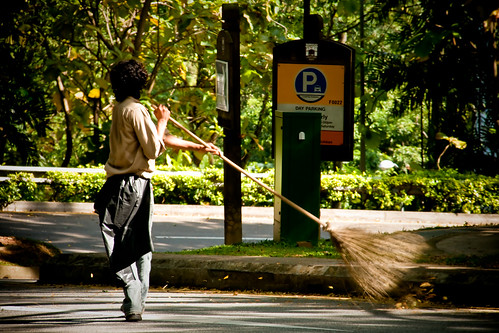
Sisters and brothers, I’m a little embarrassed to say this. But there was a time when I thought that the world was made up of basically two types of people. The hardworking people, and the lazy people. The people who made things happen, and those who simply let things happen to them. The people who strove to achieve success, and those who were content simply to remain failures. I’m not sure where I got this idea from. Perhaps it has something to do with growing up here in Singapore. Where adults would occasionally draw a child’s attention to someone cleaning the streets, but only to to say: You see that person over there? You better study hard, or you’ll end up like that. Like I said, two types of people. The active people, and the passive people. And no prizes for guessing which type I wanted to be.

Active good. Passive bad. Seems like a reasonable idea. Until we allow ourselves to pay close attention to the Mystery we are celebrating today. Today, we celebrate Palm Sunday of the Lord’s Passion. We celebrate! We glory in the Lord’s Passion! And we should not be mistaken. Here, the word passion does not mean strong emotion. What it does mean is suffering. Here, the word passion has a meaning that is the exact opposite of the word action. Here, to undergo passion is to suffer. To passively allow others to inflict pain on oneself. This is what Jesus undergoes.

In our readings today, Jesus remains shockingly passive. As we heard in the first reading: I made no resistance, neither did I turn away. I offered my back to those who struck me, my cheeks to those who tore at my beard; I did not cover my face against insult and spittle. Shockingly passive. In contrast, it is the enemies of Jesus who appear the most active. The chief priests and the scribes and the elders. These go to great lengths to have Jesus arrested and tortured and killed. And, of course, it is through the actions of the traitor Judas Iscariot, that Jesus is handed over to his enemies.

Should I then say that I was wrong? That it is not active good and passive bad, but the opposite? Passive good and active bad. Perhaps. But we have to be careful what we mean by passive. For, in today’s gospel, Jesus is not the only one who appears to do nothing. We find others as well. But not in a good sense. Consider Pontius Pilate, for example. He knew very well that Jesus was innocent. But he did nothing to help him. He sentenced Jesus to be first scourged and then crucified. And what about the other disciples of Jesus? They who received the Lord’s teaching, and witnessed his miracles. They who ate at his table, and professed their undying loyalty to him. When the crucial moment came, all these friends of Jesus deserted him. Clearly, this is a very different kind of passivity from that of the Lord.

We also have to be careful about what we mean by active. For it is not only the enemies of Jesus who appear active. In Mark’s gospel, which we read just now, we find the moving story of the woman with the alabaster jar of very costly ointment. Disregarding the snide remarks of those around her, this woman courageously anointed Jesus’ body for burial. She acted. But her action is of a very different kind from those of the Lord’s enemies.

So what is the difference, sisters and brothers? What is the difference between the passivity of Jesus, and that of Pilate and the disciples? What is the difference between the activity of the Lord’s enemies and that of the woman with the ointment? The answer, I believe, is to be found in the second reading, where we’re told that Jesus Christ’s state was divine, yet he did not cling to his equality with God but emptied himself to assume the condition of a slave. What is so praiseworthy, what is so glorious, about Jesus’ Passion, is not so much that he simply did nothing–as Pilate and the disciples did nothing–but that he emptied himself for the love of God and of humanity. He emptied himself. Even to accepting death on a cross. And didn’t the woman with the ointment do something similar? Her action was an emptying. Not just of the precious contents of her jar. But also of her very self. She acted in the face of ridicule. She acted, even when it was inconvenient. She acted for the love of Christ.

On the contrary, the passivity of Pilate and the disciples, as well as the activity of the Lord’s enemies, were geared not towards self-emptying, but self-preservation. Pilate did nothing because he wished to keep the peace, and to safeguard his job. The disciples ran away because they feared for their lives. The enemies of Jesus conspired against him because he threatened their religious authority. Active or passive, each of these people were motivated by the need for self-preservation.

Should we say then that the world is made up of two types of people: the self-emptying and the self-preserving? I don’t think so. For we know that the disciples, at least, came to regret their inaction. After Pentecost, they received courage to empty themselves, as their Master had done before them. People change. Perhaps what we can say, then, is not that the world is made up of two different types of people, but rather of two contrasting attitudes. One of self-preservation. And the other of self-emptying. One of selfishness. And the other of love.

Sisters and brothers, which attitude do you find in yourself today?

Saturday, March 24, 2012


5th Sunday in Lent (B)
Not Meant To Be That Easy

Readings: Jeremiah 31:31-34; Psalm 50:3-4,12-15; Hebrews 5:7-9; John 12:20-33
Picture: cc photofarmer

Sisters and brothers, in one of the Confucian Classics, entitled the Mencius, the story is told of a certain farmer who had planted some seed, and was waiting for his crop to mature. But the seedlings took a long time to grow. And the farmer got impatient. So he decided to help them along. Every morning, he would go out into his field and pull each seedling a little higher up in the soil, so that the seedlings looked taller than before. Needless to say, it didn’t take long before the whole crop died. What the foolish farmer thought was a faster route to maturity, turned out to be a short-cut to ruin. Growth takes time. It cannot be hurried. Some things are just not meant to be that easy.

The farmer’s foolishness is probably quite obvious to us. How could he even entertain the thought that it might be so easy to mature his crops? How could he forget that growth cannot be simply a matter of taller shoots? That it must also involve deeper roots? Some things are just not meant to be that easy. And yet, I sometimes wonder whether we ourselves don’t often fall into a similar forgetfulness.

We live in an information age. The era of social media. Everybody who’s anybody is on Facebook and Twitter. Such that even the Church has jumped onto the social media bandwagon. And this is probably as it should be. The Church needs to be where the people are. How else will the Gospel be preached to the nations. But, even so, it remains important to see that there is a significant risk attached to our use of social media. And I’m not referring to internet security. What is this risk? It is the tendency to forget the principle that the foolish farmer forgot: that some things are just not meant to be that easy.

What social media appears to offer us is exceptional ease of communication and connectivity. At the click of a mouse, you can gain hundreds, even thousands, of friends and fans. And you can broadcast your message to an even bigger number. All it takes is some computer savvy and a good internet connection. It’s as easy as that. Or... is it? Is communication and connectivity really that easy? Almost as easy as tugging on seedlings to make them grow?

If we think so, then we need to pay closer attention to what our Mass readings are telling us on this 5th Sunday in Lent. In the first reading, God too is interested in communication and connectivity. God wishes to communicate God’s love to the people more effectively. To connect with them in a more intimate fashion. To help their relationship with God to grow. But God wishes to do this in a very particular way. God doesn’t seem so interested in increasing the height and breadth of his reach, as important as this may be. Instead, God focuses on the need for greater depth. This is the covenant I will make with the House of Israel when those days arrive – it is the Lord who speaks. Deep within them I will plant my Law, writing it on their hearts. The Law that was a sign of God’s loving relationship with the people. The Law that was given to Moses on Sinai. The Law that was written originally on tablets of stone. This same Law God now promises to inscribe on hearts of flesh.

And we should make no mistake. This transcription of the Law from tablets of stone onto hearts of flesh is no easy task. For it is not just tablets that are made of stone. All too often, we allow our hearts to become stone-like as well. Through the trials that we may encounter in life, or the temptations to which we succumb, our hearts gradually become hardened. All but impervious to God’s Law. We resist God, without even being aware that we’re doing so. We may, for example, continue to abide by the rules of the Church–we may go to Mass; we may fast and abstain in Lent; we may say our prayers–and yet, continue to keep God at a distance. Such that, in order for God’s promise to be fulfilled, our hearts must first be purified. Hardened hearts must be made to crumble and be transformed, once again, into hearts of flesh. And this is no easy task. There is no short-cut available. The other two Mass readings remind us of the terrible yet unavoidable cost involved.

What is required is for the Word of God to be made flesh. To become a human being. And, having become human, when the appropriate hour arrives, to give His life as a ransom for many. In today’s gospel, it is precisely at this crucial moment on his journey that Jesus finally finds himself. Now the hour has come, he proclaims, for the Son of Man to be glorified. By which he refers to his being raised up on the wood of the Cross. For unless a wheat grain falls on the ground and dies, it remains only a single grain; but if it dies, it yields a rich harvest.

This is what it takes for stone to become flesh again. This is what it takes for the Law of God to be inscribed on human hearts. For the people to know and to grow in the love and the life of God, the seed of God’s Word-Made-Flesh must first fall on the ground and die. This is the unavoidable cost that must be borne. The terrible price that must be paid. It is no easy task. But, for our sake, and in obedience to his Father, Jesus agrees to bear this burden. He decides to enter through the narrow gate. To walk the difficult way. As the second reading tells us, although he was Son, he learnt to obey through suffering. Such that, having been made perfect, he became for all who obey him the source of eternal salvation.

All this reminds us, sisters and brothers, of the very principle that we tend so easily to forget today, in this media-saturated era in which we live: That there are really no short-cuts to growth in intimacy. No easy paths to authentic communication and true connectivity. If we want real friends, there is no substitute for taking the time and making the effort to engage another in sincere conversation, and even, when the occasion calls for it, in open argument. If we wish to preach the Good News of God’s love for us, there is no substitute for first experiencing it, and being immersed in it ourselves. Even if we have, in some way, to fall on the ground and die. As I heard someone say recently, to give it, you have to live it. Some things are just not meant to be that easy.

The only reason why it so often seems otherwise is because, like the foolish farmer from the Mencius, we have been conditioned to mistake appearances for reality. To think that seedlings are growing just because they seem taller than they were before. To equate the number of hits on websites, or the number of friends on Facebook with true effectiveness in ministry. This tendency is but a sign of our times. As the current Superior General of the Society of Jesus has so astutely observed, ours is not just the era of social media. It is, alas, also characterized by the globalization of superficiality.

Sisters and brothers, contrary to what we may be conditioned to think, authentic communication and real connectivity are not just about faster computers and increased bandwidth. Some things are just not meant to be that easy. True growth in the life and love of God is a narrow gate, and a difficult road. It is, ultimately, a matter of life and death. It involves our immersion into the Dying and Rising of Christ. Which we have gathered here this evening to celebrate.

Sisters and brothers, how ready are you to enter this difficult but life-giving Mystery today?

Saturday, March 17, 2012


4th Sunday in Lent (B)
Between the Living and the Dead

Readings: 2 Chronicles 36:14-16,19-23; Psalm 136:1-6; Ephesians 2:4-10; John 3:14-21

Sisters and brothers, are you familiar with the 1999 film entitled The Sixth Sense? It stars Haley Joel Osment as Cole, a boy who is troubled by a secret ability. He sees dead people. Not dead bodies in hospitals, or mortuaries, or coffins. But dead people, who continue to walk around as though they were still alive. Dead people, who don’t know that they are dead. Dead people, like the teenage girl who keeps showing up and vomiting, because she was poisoned by her mother. Or the boy who walks around with a bloody hole in the back of his head, where his father shot him, before committing suicide. Dead people, who terrify and torment poor Cole, because they insist on talking to him, and telling him their stories.

Only later does Cole gradually come to realise that these dead people actually need his help. All of them are trapped by something in their past. Some unfinished business that prevents them from moving on. And it’s only when Cole summons up the courage to listen to their stories, that he is somehow able to help them to find release. To find freedom.

Dead people, walking around like regular people. Dead people who don’t know that they’re already dead. I know. Sounds pretty far-fetched doesn’t it? Sounds like what you’d find only in a horror movie, but not in real life. And yet, isn’t there something similar in our scripture readings today?

In our first reading, for example, don’t we find a description of a nation that only appears to be alive, but is, in fact, already dead? For the people of Israel, their worship in the Jerusalem Temple and their occupation of the land in Palestine were central to their identity as a people. But the Babylonians had destroyed the Temple, demolished the walls of Jerusalem, and deported Israel to Babylon. So that although the people continued to live on as individuals in exile, they were dead as a nation. They were dead people, who continued to walk around in a foreign land as though they were still alive.

But that’s not all. Even before this political dying had overtaken them, the people had already been suffering from another, even more serious, form of death. Again, the reading describes this quite vividly. Even before the Babylonians destroyed the Temple, the people themselves had desecrated it with various idolatrous practices that they had copied from those living around them. Not only had they defiled God’s house by worshipping other gods within its precincts, they also refused to listen to the prophets that God had sent to persuade them to change their ways. So that, before dying politically, at the hands of the Babylonians, the people of Israel had already inflicted upon themselves a spiritual death. Even while they were still living in their own land in Palestine, they were already in spiritual exile. Trapped in the darkness of their idolatry. They were dead people, who continued to walk around like the living. Dead people, who just didn’t know that they were already dead.

And, like the dead people in the movie, Israel could do nothing to help herself. She needed a saviour. Someone who was willing and able to release her, to help her to find freedom. In the first reading, God raises up the Persian king, Cyrus, to fulfil this role. Upon coming to power, Cyrus releases the exiles and encourages them to return to Jerusalem to rebuild the Temple. Through Cyrus, the trapped find release. The dead begin to come to life.

We find a similar pattern in the other two readings as well. As it turns out, it is not just the ancient people of Israel who were dead. It is the whole human race. It is all of us. You and I. As the second reading tells us, we were dead through our sins. We may have continued to walk around as though we were alive. But we were, in fact, already dead. We were trapped in our selfishness. Our lives revolving only around our own narrow concerns and interests. Unable to find release. Like the exiled Israelites of the first reading, we needed a saviour. Cyrus was raised up for them. Jesus was sent for us. He was lifted up on the wood of the Cross, just as Moses lifted up the serpent in the desert, so that everyone who believes may have eternal life in him.

Which is why we observe this great season of Lent. To prepare ourselves to renew our baptismal promises. The promises by which we die to our sins, and are raised to life in Christ. To prepare ourselves to be sprinkled once again with the healing waters flowing from the pierced side of the Crucified Christ. We spend this precious time recalling what it’s like to be dead people. To be walking around as though we were alive when, in fact, we are already dead. We spend this time reminding ourselves of how easy it is to be dead and not even know it. So easy to act as though our lives were filled to overflowing with so many different things. So many items of business. Even apparently pious business. And yet still feel so strangely empty and restless. So busy. And yet so lifeless.

Sadly, isn’t this what we see around us all too often? People who may appear, externally, to be in the pink of health and wealth. Beautiful, well-dressed, well-to-do people. But, whose actions often make it clear that they are really already dead. That, for various reasons and in different ways, they have been conditioned to care for nothing and no one other than what’s in it for me, myself, and mine. Isn’t it also true that even marriages and families, careers and even religious vocations like mine can become this way as well? Only going through the motions of life. But actually already quite dead. Dead people, who just don’t know yet that they are already dead. Dead people who can’t help themselves. Dead people in dire need of someone to help them.

All of which should give greater impetus to our Lenten discipline. For we Christians undergo the rigours of Lent not just for ourselves. We prepare to renew our baptismal promises not just so that we can enjoy eternal life ourselves. We do so, also because we know that the light of Christ is given not just to us, but also through us to others. Like the boy Cole in The Sixth Sense, we too are somehow gifted with the ability to see dead people, but only so that we can help them to find release. To help them to encounter the Crucified and Risen Christ, the God-given saviour, in whom is to be found the fullness of life.

Sisters and brothers, on this fourth Sunday of Lent, do you see any dead people around you, people who need your help today?