Sunday, November 28, 2021

With Blinders Removed

1st Sunday of Advent (C)


Readings: Jeremiah 33:14-16; Psalm 24(25):4-5,8-9,10,14; 1 Thessalonians 3:12-4:2; Luke 21:25-28,34-36

Pictures: cc City of St Louis Missouri


My dear friends, do you know what blinkers or blinders are? They are sometimes put around a horse’s eyes, so that it can see only what is directly ahead. This prevents the horse from getting distracted or startled by its surroundings. Which may be a good thing, except that it narrows the view of the horse.


I don’t know if you’ll agree with me, but I think we often look at Christmas, as though we too were wearing blinders. Commercially, Christmas is presented as a season for giving and merry-making. Which makes it a precious time for buying and selling. That’s only to be expected. But I suspect that even those of us, who may be more religious, will be surprised, if we were told that Christmas is more than just a celebration of the birth of Christ two thousand years ago.


Which is one good reason why we need Advent, and especially this first Sunday of Advent. As you may have noticed, in our readings today, there is no mention of a baby in a manger. Indeed, our attention is directed, at least initially, less to the past, than to the future. The gospel begins with a rather disturbing, and even scary, description of the end times. Jesus says that people on earth will be dying of fear as they await what menaces the world, for the powers of heaven will be shaken… How do you feel when you hear these words?


I confess that I’m tempted simply to ignore them. To skip ahead to the less troubling parts of the gospel. Which is, of course, just another way of putting on blinders, isn’t it? And I know why I do this. It’s the same reason horses do it. To avoid being scared and distracted. Distracted from what exactly? From the routine busyness and stress of daily living.


And yet, in the gospel, Jesus offers a different antidote to fear. Instead of covering our eyes, he strengthens our hearts, and guides our steps. He strengthens our hearts by telling us that, if we truly follow him, then the end times are not to be feared, but welcomed: When these things begin to take place, stand erect, hold your heads high, because your liberation is near at hand. And he guides our steps, by warning us that the routine busyness of daily living can itself be a distraction: Watch yourselves, or your hearts will be coarsened with debauchery and drunkenness and the cares of life…


In effect, Jesus is reminding us that the promise made in the first reading has already been fulfilled in him. That we, the body-of-Christ on earth, we too bear the name the-Lord-our-integrity. For Jesus has already shown us how to face the end without fear. By living the kind of life we are meant to live: the life that God wants. By continually asking God to increase our love, making us love one another and the whole human race.


Sisters and brothers, we don’t really have to wait till the end times to see scary signs. We can already see them now: the growing climate crisis, multiplying COVID-19 variants, desperate migrants drowning in the sea… Still, Christ is with us already. What must we do to let God remove our blinders, and better prepare for the Lord’s coming again today?

Sunday, November 14, 2021

A-R-T


33rd Sunday in Ordinary Time (B)


Readings: Daniel 12:1-3; Psalm 15(16):5,8-11; Hebrews 10:11-14,18; Mark 13:24-32

Picture: cc Jernej Furman


My dear friends, have you taken an A-R-T yet? What did it feel like? What result did you get? As you know, A-R-T stands for antigen rapid test, which is a quick way to detect a possible COVID-19 infection. Similarly, our Mass readings also provide us with a kind of A-R-T, a convenient test to indicate whether or not we have a certain kind of infection.


As you’ve probably already noticed, the first reading and the gospel share certain characteristics. They are both examples of apocalyptic literature. This type of writing is addressed to a particular kind of audience, to people suffering persecution, people at the bottom of the prevailing societal order. Scholars tell us that the first reading was originally intended for Jews who had been conquered by the Greeks, and the gospel for those being oppressed by Roman rule.


To such people, the apocalyptic message is simple. Yes, you are suffering now, but do not to be afraid, because the current world order will not last forever. A time is coming, a time of great distress, when everything will be disrupted, turned upside down, when even those who are powerful now will be made powerless. After which, God’s previously hidden presence will be made manifest. And those who had remained faithful to God will be gathered and rewarded. While those who had been unfaithful will be punished.


How do you think you would feel, if you heard this message? Well it depends, right? If I were suffering for being faithful to God in a hostile world, then I might feel encouraged and hopeful, I might find the strength I need to persevere. But if I were unfaithful, if I had somehow allowed myself to become a friend of the world, then I’d likely feel anxious and afraid, or I might perhaps try to ignore the message. Whatever it is, my reaction serves as an indicator of a possible infection. It tells me whether I have been contaminated by the world.


My dear friends, I think this is also what our readings can do for us today. They serve as an A-R-T. Not an antigen rapid test, but an apocalyptic reading test. My reaction to them may indicate how faithful I am to God, whether I am truly striving for that eternal perfection won by the single sacrifice of Christ, or whether I have been infected by the world.


And in case this test, this A-R-T, isn’t reliable enough, I can supplement it with a P-R-T, a pandemic reaction test. I may examine my reaction to the distress and disruption caused by the pandemic. Am I, like most others, looking forward only to things going back to the way they were before? Is my idea of the new normal just another version of the comfortable past? Or am I also yearning for a radically different future, where the poor will be better provided for, the environment better cared for, where God’s kingdom will more fully come, God’s will be more truly done, on earth as it is in heaven?


Sisters and brothers, if we were to honestly submit ourselves to a spiritual A-R-T today, what will it feel like? What result will we get? How might we draw ever closer to Christ, today?

Sunday, November 07, 2021

Checking Our Cheese...


32nd Sunday in Ordinary Time (B)


Readings: 1 Kings 17:10-16; Psalm 145 (146): 7-10; Hebrews 9:24-28; Mark 12:38-44

Picture: cc Marco Verch Professional Photographer


My dear friends, do you know when cheese is not really cheese? I must confess that I was very surprised, when I was told the answer not long ago. Apparently, a popular brand of individually packed cheese slices actually contains so little cheese, that it has to be called a cheese product. Which just goes to show how important it is for us not to simply take things at face value. Just because something is described as cheese, doesn’t mean it actually contains real cheese. Better to take a closer look, to find out more… Otherwise we may end up eating something far less nutritious than advertised.


I mention this because food is also a central feature of our readings today. We see this most clearly in the first reading. In a time of famine – a dire shortage of food – caused by drought, the prophet Elijah begs a poor Sidonian widow to feed him. And she willingly shares with him the little food she has. But why, we may ask, does the prophet beg from such a poor person? And why is this particular widow so generous?


The reading begins at verse 10. We find the answers to our questions in verses 8 and 9. There we are told that it was the Lord, who instructed Elijah to seek out the widow, and that it was also the Lord, who commanded her to feed him. All of which indicates that both Elijah and the widow did not simply share the same food for their stomachs. They also shared the same nourishment for their souls. By acting as they did, they were both obeying, feeding on, the word of the Lord.


In the gospel too, we find a poor widow, who generously donates to the Temple all she had to live on. The gospel doesn’t tell us why she does this. But we may assume a similar motive to those of Elijah and the first widow. Like them, she probably thinks she is obeying God, that she is feeding on the word of the Lord. But notice what Jesus says at the beginning of the reading. He tells his disciples to beware of the scribes, to guard against the very people responsible for the financial system the widow is obeying. Why? It’s because of the food they eat… They swallow the property of widows, while making a show of lengthy prayers… Instead of feeding on the word of God, these religious leaders feast on the livelihoods of the poor, whom they fool into thinking they are obeying God. Which is not so different from selling cheese that’s not real cheese, right?


Unfortunately, such things still happen today. The recent case of that poor woman, who became very sick after buying and ingesting the drug Ivermectin, as protection against Covid-19, is just one, more obvious, example. She did this on the advice of Catholic friends, who led her to believe it was what God wanted. Thankfully, by generously sacrificing himself once and for all, Christ has established this eucharistic table, from which we are fed, and at which we are given what we need to judge the true nutritional value of every other food.


Sisters and brothers, what must we do to be more vigilant, and to help one another to carefully check our cheese today?

Sunday, October 24, 2021

Between Hentak Kaki & Cepat Jalan


30th Sunday in Ordinary Time (B)

(World Mission Sunday)


Readings: Jeremiah 31:7-9; Psalm 125(126); Hebrews 5:1-6; Mark 10:46-52

Picture: cc Richard Lee


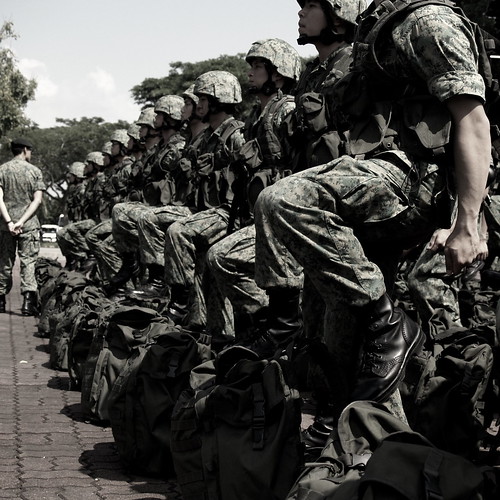
My dear friends, do you know what hentak kaki means? For those who don’t, it’s a command in Malay, given to soldiers on parade, telling them to march on the spot. Which they are then expected to do, until they receive a further command, for example, to cepat jalan, to resume marching forward briskly. Anyone who has ever hentak kaki before, knows how tiring and frustrating it can be, especially under the hot sun. But this term is not just confined to the military. It’s also used at the workplace, to describe those who are repeatedly passed over for promotion. Like soldiers marching on the spot, such employees are also said to hentak kaki…


The frustration and fatigue, the sense of futility and even hopelessness that often results from remaining stuck in the same place, for a protracted period of time, despite making strenuous efforts to move ahead. This is also the experience of the people we meet in our readings today. In the first reading, the Word of God is addressed to the remnant of Israel, a people stuck in exile. God promises to comfort and care for them, to gather them and to guide them safely home.


Similarly, in the gospel, more than just being blind, Bartimaeus is also stuck by the side of the road. Thankfully, though his eyes are sightless, his faith enables him to recognise his Rescuer. At a word from Jesus, the stranded beggar receives not only his sight, but also his freedom. He is able to jump up, and to gratefully follow Jesus along the road. As a result, Bartimaeus becomes not only a disciple of Christ, but also an adopted child of God.


The proclamation of release to captives, of recovery of sight to the blind, and of freedom to the oppressed (Lk 4:18). This is the marvellous mission that Jesus carries out in our readings today. The mission given to the only begotten Son of God, who descends among us as high priest, appointed by God to set stranded people free. This is also what we recall especially today, on World Mission Sunday. Not our mission, but the mission of God, entrusted by the Father, to the Son, in the Holy Spirit. This is the mission from which we ourselves have benefitted, as Bartimaeus did. By virtue of our baptism into Christ, we too receive adoption as children of God, washed in the blood of the Lamb, and made partakers at his eucharistic Table.


More than any sense of obligation, it is deep gratitude for the mission entrusted by God to the Crucified and Risen Christ that then impels us to share the Good News of liberation with those who may remain stranded. As Pope Francis reminds us, to be ‘in a state of mission’ is a reflection of gratitude. It is in gratitude for gifts received that we, in our turn, accept and act on the command to become missionaries to those in need, especially in these trying times. People overwhelmed by fatigue and frustration, whether by the lack of work or by too much of it. People oppressed by a sense of futility, either because their options are too few or far too many...


Sisters and brothers, at a time when many remain stranded, how are we being commanded to cepat jalan today?

Saturday, October 16, 2021

The Games People Play


29th Sunday in Ordinary Time (B)


Readings: Isaiah 53:10-11; Psalm 32(33):4-5,18-20,22; Hebrews 4:14-16; Mark 10:35-45

Picture: cc woodleywonderworks


My dear friends, if you happen to come across a group of people running around on a basketball court, passing a ball to one another, is it safe to assume that they are playing basketball? The answer, of course, is no, not necessarily. They could, for example, also be playing a game called futsal. A scaled-down version of soccer, played on a hard court. Which goes to show that, if we want to determine what game people are playing, it’s not enough just to consider where they are. It’s also important to look at what they do. Are they using their hands, or their feet? Are they throwing a ball through a hoop, or kicking it between two posts?


The same can be said about what we find in our readings today. But first, it may be helpful to recall that, in chapter one of Mark’s gospel, Jesus had called James and John, the sons of Zebedee, to leave their fishing boat, and to become fishers of people. From then on, we might say that, the brothers had left their old field of play, and joined Jesus in a new one.


And yet, here in chapter ten, we see them engaging in what amounts to a brazen act of shameless self-promotion. Which indicates that, though they may be sharing the same field as the Lord, they aren't actually playing the same game. As a result, Jesus takes the trouble to gather all twelve apostles, to teach them how to distinguish between two very different games, by considering how authority is exercised in each one.


In the game of worldly competition, authority is exercised through domination. The so-called rulers lord it over their subjects, as James and John were probably hoping to do. In contrast, in the game that Jesus plays, authority is exercised through service. (A)nyone who wants to be great among you… must be… servant… and… slave to all.


And the Lord teaches this lesson not just with his words, but also by his actions: his life, death and resurrection. As the other readings tell us, he is the supreme high priest who has gone through the highest heaven, but only by first descending into the depths of the earth. By allowing himself to be tempted in every way that we are, though without sin. By offering his life in atonement, so that by his sufferings, he is able to reconcile us to God and to one another.


This is the same game that we Christians are called to play, in all the different arenas of daily life. At home or at work, in church or on the streets. To consistently choose loving self-sacrificing service over shameless self-promoting domination. And we probably all know this well enough in theory. It’s just that we don’t always see how it translates into practice. Which is why we really need this synod on synodality, for which we are beginning to prepare today. As we go through the process together, we hope to learn, as a church, how the game is played. How both leaders and subjects alike can find God, by truly listening and speaking with one another, and with the world.


Sisters and brothers, if it is true that a game is determined less by the field of play than by the actions of the players, then what game are we playing, everywhere and everyday?