Tuesday, May 06, 2008


Tuesday in the 7th Week of Easter
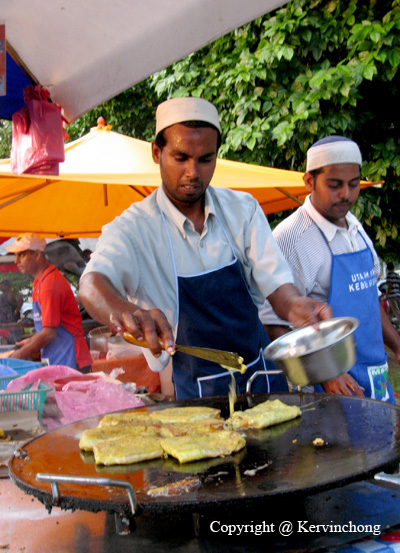
Murtabak Man


Readings: Acts 20:17-27; Psalm 68:10-11, 20-21; John 17:1-11
Picture: CC Kervinchong

Have you ever seen a murtabak man at work? You know, the guy who makes those Indian pancakes. Don’t you find the process fascinating? First the dough needs to be prepared and molded into the right shape. Then each ball of dough is carefully kneaded and stretched. The different ingredients are added: oil, meat, eggs, onions... whatever the customer orders. The whole thing is then carefully folded up, thrown onto the frying pan, drenched with copious amounts of oil, and left to brown to a crisp. And there you have it, a delicious piece of murtabak served with the curry of your choice.

This is the image that comes to mind even as we continue to prepare our hearts for Pentecost, by pondering the power of the Holy Spirit. As bizarre as it may sound, the murtabak man is what we are reminded of as we listen to the two farewell speeches in our readings today. These are speeches delivered by two very different people, addressing different audiences, in separate locations. In the first reading, Paul finds himself at the port city of Miletus, speaking to the elders of the Ephesian church. In the gospel, Jesus is at table with his disciples at the Last Supper, where he offers a prayer to his heavenly Father. But, in spite of these differences, the background and the gist of what is said are actually very similar. Both Paul and Jesus are at crucial milestones on their respective journeys. Each of them will soon embark on a journey that will bring them into the fiery furnace of suffering and death. From Miletus, Paul will go to Jerusalem and then on to Rome, where he will be tried and beheaded. From the supper room, Jesus will depart to walk the lonely way of the Cross.

These are horrifying prospects. These are itineraries that would make people run away, or paralyze them with fear. And yet, what is so amazing is the way in which both Paul and Jesus face their approaching end. Each one first looks back on all the different things that he has done and finds in them a unity of purpose. Life to me is not a thing to waste words on, says Paul, provided that when I finish my race I have carried out the mission the Lord Jesus gave me… Jesus says something similar to his Father: I have glorified you on earth and finished the work that you gave me to do… And this sense of a unity of purpose in their past is also what gives each one the courage to face what is to come. What seems so terrifying from a worldly perspective is viewed as glorious from the vantage point of eternity. But this is not the fanatical zeal that drives suicide bombers to their deaths. For both Paul and Jesus give their lives not to maim and to kill, but so that others might be led into the fullness of life.

It is as though, even as each one prepares to be thrown onto the fire, he looks back and sees the different threads of his life being pulled together, as one might assemble the ingredients for an Indian pancake. In this light, the approaching flames are viewed as the climax of a life spent heeding the call of the God who wants only to feed his people. And this whole process, as well as the perspective from which it can be appreciated, is empowered by the Holy Spirit, the same Spirit for whom we are praying in these days. This is the divine Murtabak Man by whose power our disparate lives can be drawn into a unity and then thrown into the fire of God’s service, but only so that others might be fed. This is the same One whom we will invoke at this Mass, so that the bread that is offered might also be broken for the life of the world.

How might we experience the power of the Murtabak Man today?

Monday, May 05, 2008


Monday in the 7th Week of Easter
Scratching Chickens and Soaring Eagles


Readings: Acts 19:1-8; Psalm 68:2-3ab, 4-5acd, 6-7ab; John 16:29-33
Picture: CC Carl Chapman

We might perhaps be forgiven for thinking that the story in the first reading has nothing really to do with us. For, at least at first glance, it merely presents a contrast between two religious rituals: the baptism of John and that of the Lord Jesus. Although both are seen as important, the second is more significant. It completes the first. And most, if not all of us, present here will have already satisfied the requirements of the second ritual. Not only have we been baptized in the name of Father, the Son and the Holy Spirit, but we have also been anointed with the oil of holy chrism at our Confirmation, and been admitted to the table of the Lord in the Eucharist. We have already gone through the ritual that the reading requires, and more. Is there anything else that the story has to tell us?

Probably. But first we need to look beyond the rituals to the respective experiences and ways of living to which they point. Consider for a moment, what it might be like for those who have only undergone the baptism of repentance. We can only guess, of course. But could it be something along the following lines? These people have taken a big step in deciding to turn away from sinful ways and to live God-fearing lives. This is what the ritual expresses. It is likely that these same people will be trying very hard to stay away from sin. But, as we may know from experience, this is not easy. And, because they may be too focused on their own performance, it is likely that they face the risk of falling into one or the other of the following temptations. Either they may fail to live up to their own expectations and give up in disillusionment and despair, as Judas did. Or they may become too pleased with their own achievements and succumb to the pride and hypocrisy of the Pharisee.

In contrast, the experience of those baptized in the Lord is different. Although they too are committed to living God-centered lives, their focus is less on themselves – on their own sin, on their own performance – than it is on the Lord. Their efforts are invested not so much in resisting temptation – as important as this is – than in bearing witness to the Lord’s Life, Death and Resurrection. We see this in the actions of Paul who entered the synagogue, in Ephesus, and for three months debated boldly with persuasive arguments about the Kingdom of God. Even in the face of opposition, Paul courageously continues his mission. He provides for us an example of what Jesus speaks about in the gospel: in the world you will have trouble, but take courage, I have conquered the world.

I’m reminded of that well known story told by Tony de Mello about how someone places an eagle’s egg in a chicken coop. The eaglet hatches and grows up living like a chicken, scratching the ground with its claws and pecking at the dirt with its beak. Then, one day, when it has grown old and frail, it happens to see an eagle soaring majestically high up in the sky. And it thinks to itself, how wonderful it would have been had it been born an eagle.

More than just a contrast between two rituals, the first reading presents us with a difference between two ways of life. And at the root of this difference lies the very thing that we are praying for with renewed fervor especially in this week leading up to the great feast of Pentecost. We are asking for a fresh experience of the power of the Holy Spirit, the same Spirit whom we received at baptism and confirmation. We want to feel again the Spirit’s power. For in this experience lies the difference between the chicken that scratches the dirt and the eagle that soars in the sky.

How does the Lord wish to anoint us anew with his Spirit today?

Friday, May 02, 2008


Friday in the 6th Week of Easter
Memorial of St. Athanasius, Bishop and Doctor of the Church
Overcoming Inertia


Readings: Acts 18:9-18; Psalm 47:2-3, 4-5, 6-7; John 16:20-23
Picture: CC WeeBeastie!
Please go to Archive

Thursday, May 01, 2008


The Ascension of the Lord (A)
Why Are You Still Standing Here?


Readings: Acts 1:1-11; Psalm 47:2-3, 6-7, 8-9; Ephesians 1:17-23; Matthew 28:16-20
Pictures: CC iZENstein

Sisters and brothers, why have so many of us come here today? We know, of course, that it is a day of obligation. But why is it a day of obligation? Why is this day deemed important enough for us all to be obliged to come to Mass? We all know that we celebrate the solemn feast of the Lord’s Ascension. But why is this so important as to merit requiring us to come to church? And, in any case, doesn’t it seem strange that we should be asked to joyfully celebrate an occasion on which our precious Lord leaves us? Where’s the joy in that? Aren’t departures more occasions for sadness than of joy?

In reflecting upon these questions, it’s important first to remember that we remain in the season of Easter. We continue to celebrate and to contemplate the single Mystery that is the Lord’s Dying and Rising. Along with Easter Sunday, today’s feast and the feast of Pentecost – which we will celebrate two Sundays from now – are part of a single celebration, part of a single Mystery. More than simply a commemoration of a sequence of events – first the Lord’s Rising from the dead, then his Ascension into heaven, and finally the Descent of the Holy Spirit – each of these feasts helps us to deepen our appreciation for different but related aspects of the one Easter Mystery.

What then is so significant about Ascension Thursday? What does it add to our contemplation of Easter? I believe today's feast highlights something about the Lord’s Resurrection that is often quite easily missed. Have you, for example, ever felt even a little disappointed or confused by Easter Sunday and the days following it? Have you ever felt at least a little envious of those early disciples who were blessed with the joy of encountering the Risen Lord face to face during that first Easter? How easy it must have been for them to rejoice. The Risen Christ was bodily present to them. He ate and drank with them. He blessed and prayed with them. But what about us, who celebrate Easter today? Where is the Lord’s presence among us? How are we to be joyful when he sometimes seems so painfully absent, when we neither see him nor hear him, or so it seems?

What we so easily miss, when we listen to the gospel stories of the apparitions of the Risen Christ, is how elusive he is. When Mary Magdalene reaches out to touch him at the tomb, he immediately tells her not to cling to him and then quickly sends her away (Jn 20:17). When the disciples on the road to Emmaus finally recognize him at the breaking of bread, he mysteriously vanishes from their sight (Lk 24:31). What do these incidents tell us if not that the presence of the Crucified and Risen Christ is a presence in absence. It is not something that we can cling to or store in a safe deposit box, as we might a precious possession. Rather is it instead something that possesses us, something over which we have little if any control, something in which we put our trust, something that gives us hope.

And it is this crucial aspect of Easter, this hope-inspiring presence in absence that today’s feast strikingly brings to our attention. We cannot have failed to notice, for example, how Jesus tells his disciples in the gospel, just as he is being taken from their sight, that I am with you always… to the end of time. He ascends into the heavens, and yet he says he is with us: presence in absence. This may at first seem a bit too much for us to grasp. How can someone be both present and absent at the same time? And yet, don’t we have similar experiences in daily living?

Think, for example, of a person, let’s call him Matt, working in a local office of a foreign company. Things are very difficult, because many procedures in the office are unsuited to local conditions. Plenty of changes need to be made, changes that Matt tries to implement, only to encounter considerable opposition, and even animosity, from longer-serving colleagues. Thankfully, Matt finds a mentor in his supervisor, who supports his initiatives. Under the supervisor’s patronage, reforms get underway. But, before the changes are completely implemented, the supervisor suddenly gets posted overseas, which makes Matt very depressed and apprehensive. Then his supervisor calls him for a chat and explains to him that she is actually being promoted to a regional managerial position, from where she will have the authority to better oversee and further implement the changes that they have been working on together. In her absence, he should continue his work and keep her posted. Matt is much relieved and encouraged after hearing this, because even though the supervisor will no longer be physically present, her newfound authority will give him the protection and support he needs to continue the work he has been doing, perhaps to an even greater degree. Hers will be a presence in absence.

More than that, and just as importantly, hers will also be an authoritative presence. She will be in charge, even more so than before. And this is yet another significant aspect of today’s feast. The Ascension reminds us that Jesus is raised not only to new life, but also to the right hand of God the Father. And our readings tell us what this means. It’s not just that we are to imagine Jesus seated next to the Father on some imaginary throne in the clouds. Rather, as the second reading tells us, has he been raised far above every Sovereignty, Authority, Power or Domination, or any other name that can be named, not only in this age, but also in the age to come. Jesus puts it more simply in the gospel: all authority in heaven and on earth has been given to me. The Ascension reminds us not only that the Jesus’ presence among us is a presence in absence, but also that it is a presence of ultimate authority. Christ the Lord has been put in charge.

This too is what gives us hope. And hope is what moves us to respond to yet another important aspect of today’s feast, yet another characteristic of Christ’s presence among us. Not only is it a an authoritative presence in absence, but it is also a presence that sends us out, a presence in mission. As Jesus says in the gospel: go, therefore, make disciples of all the nations…

Why then are we here today, sisters and brothers, if not to celebrate and to experience anew this marvelous ongoing presence of the Crucified and Risen Lord in our midst? Here, in this church, we are gathered as an assembly of believers to listen to his Word and to break the Bread as once he did with the disciples at Emmaus, and so to allow our hearts to burn within us, moving us to go wherever he sends.

Sisters and brothers, we began our meditation with a question. We asked ourselves why we have come. Perhaps it is fitting that we also close with another question. And what better question than the one that we find in the first reading today? Given that our Crucified and Risen Lord is so authoritatively present among us, given that he now sends us on the same mission that was entrusted to him by his heavenly Father, can we afford to continue standing here looking into the sky?

Wednesday, April 30, 2008


Wednesday in the 6th Week of Easter
Designers or Tailors


Readings: Acts 17:15, 22-18:1; Psalm 148:1-2, 11-12, 13, 14; John 16:12-15
Pictures: CC Lawrence Sinclair

I know next to nothing about the fashion industry. But an occasional cursory glance at such programs as Project Runway and America’s Next Top Model sometimes leads me to wonder at the exact aim of those who operate in the rarefied atmosphere of high fashion. To my uninitiated eyes, it often seems that instead of trying to make clothes that fit people – real people – the goal is instead to choose the right people – the right models, the right buyers – to fit the clothes. How different is this scene from the far more down-to-earth one found in the humble tailor shop (if we still remember what that looks like), where much energy is spent on taking the right measurements to ensure a comfortable fit. Such seems to be the contrast between designers and tailors. The former moulds models to match the material, while the latter cuts the cloth to fit the customer.

This contrast is a useful one to keep in mind when reflecting on our relationship with God. For the approach of the fashion designer is precisely the one that Paul is speaking against in his address to the Athenians in the first reading. Rather than humbly receiving the divine revelation as to what God is like and how God acts, people with the designer mentality seek instead to mould God according to their own whims and fancies. As a result, however faithful they may seem to be in performing routine rituals of worship, they end up merely paying homage to false gods, products of their own design, idols of their own making. The One True God remains unknown to them. Which is a very serious situation, since eternal life consists in knowing the one true God and Jesus Christ whom God has sent (see John 17:3).

It is this serious situation that the Holy Spirit and Paul are sent to redress. As Jesus tells us in the gospel, the Spirit of truth… will guide you to all truth. And it is this truth about God that Paul proclaims in the first reading. In contrast to the designer mentality, Paul demonstrates a tailor’s sensitivity. Even when speaking about the One True God, Paul tries to measure and fit his words to his listeners. He makes reference to their prevailing practices of devotion. He praises them for being very religious. He argues reasonably, as one of their philosophers might. He couches his message in terms that they can understand. In particular, he emphasizes the otherness of God (the Lord… does not dwell in sanctuaries made by human hands, nor is he served by human hands…), as much as God's nearness to us (in him we live and move and have our being). He also stresses God’s desire to be found by his wayward children (for we too are his offspring).

But however much Paul tries to tailor his message to his audience, there is one crucial non-negotiable aspect that he cannot, and dare not, water down. For this is the crux of the matter. This is the central aspect of the Mystery: God has given all authority to Jesus the Christ, who died and was raised to life for us. And this is something that the designers cannot accept. They are unwilling to tailor their own viewpoints – they are unwilling to cut the cloth of their own lives – to fit the contours of this mind blowing Mystery.

And doesn’t Paul’s experience at Athens present us with a mirror? Doesn’t it invite us to reflect upon our own worship and our own lives? In our relationships with God and with one another, to what extent are we willing to acknowledge the truth of what is before us? Or to what extent do we seek to mould God and others into our own image and likeness? The former is the way to truth and the fullness of life. The latter leads to the relegation of the One True God to the status of an unknown god.

How are we being challenged to forsake the designer in favor of the humble tailor today?