Saturday, August 30, 2008


Memorial of the Martyrdom of St. John the Baptist
Follow Your Bliss


Readings: 1 Corinthians 1:17-25; Psalms 33:1-2, 4-5, 10-11; Mark 6:17-29
Picture: CC decor8

Follow your bliss! Curiously, these words coined by the late professor of mythology, Joseph Campbell, are what come to mind on this day when we celebrate – yes, celebrate! – the beheading of John the Baptist. They are, of course, very easily misinterpreted, especially by this consumeristic society of ours. At first glance, they would seem to encourage us to embrace the very thing that our Mass readings for today are warning us against.

For there is in both readings a clear distinction between wisdom and foolishness, between truth and falsehood, between self-sacrifice and self-indulgence. John the Baptist models for us what the former half of these pairs looks like, just as Herod and his household illustrate the latter. John fearlessly speaks God’s word, even when it is inconvenient, even when it is dangerous, even when it loses him his head. In contrast, Herodias is willing to commit murder for the sake of expedience – to permanently remove the bearer of an inconvenient truth. And, afraid to appear weak in the sight of his guests, Herod falls prey to her scheming, just as he had earlier given in to his own self-indulgence. It is not lawful for you to have your brother’s wife…

It’s easy to think, then, that what we are being presented with is a simple and straightforward contrast between pain and pleasure. To live the way of the wisdom, the way of the cross, the way of Christ, is to forsake the way of delight. After all, wasn’t it Herod’s enjoyment of a young girl’s dancing that led him take a prophet’s life? We need to deny our natural inclinations and embrace only that which makes us suffer. Or do we? Is there not something else that we need to consider? Should we not notice, for example, that Herod had initially kept John alive, because he liked to listen to him.

Could it be that the contrast we are being invited to consider, is not so much between pleasure and pain, as it is between two different kinds of inclinations? Could it be that true wisdom consists in the ability to discern our delights, in learning to truly find and follow our bliss? For Herod’s foolishness consists in his indulgence in a more superficial delight – saving face before his guests – at the cost of another deeper, more enduring one – being led by John’s message to an encounter with God in Jesus the Lord. In contrast, for the sake of delighting in the goodness of God, of which the earth is full, John the Baptist was willing even to sacrifice his life.

How are we being invited to truly follow our bliss today?

Friday, August 29, 2008


Thursday in the 21st Week of Ordinary Time
Memorial of St. Augustine, Bishop and Doctor of the Church
Sleeping To Stay Awake


Readings: 1 Corinthians 1:1-9; Psalms 145:2-3, 4-5, 6-7; Matthew 24:42-51
Picture: CC jonnykeelty

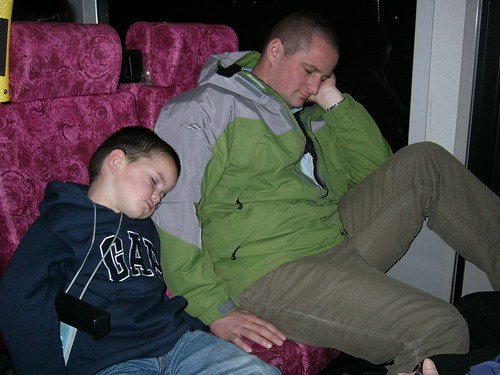
On the approximately 3-hour long bus ride from the airport to my final destination, I wanted very much to stay awake. I wanted to take in the scenery provided by the coastal drive. I wanted to notice important information, details about the various exits along the freeway, for example. But the rigors of the flight across the Pacific proved just a little too much – I had tried not to sleep for any extended period on the plane, in an effort to avoid jetlag. As a result, more than half of the precious bus ride found me in dreamland.

This is the experience that is brought to mind as we listen to Jesus exhort the disciples to stay awake and stand ready because the Son of Man is coming at an hour you do not expect. We all know that this is easier said than done. Like what I found on the bus, the desire to sleep can prove too overpowering. We succumb so easily to the zee-monster, and before we know it the scenery has passed us by. Ever so stealthily, the Son of Man may have come and gone, without us being any the wiser. Is there anything we can do to help ourselves stay awake?

Perhaps the first thing is to notice what staying awake entails. While we may think only in terms of staying away from the more obvious occasions of sin – not getting angry with others, for example, or shielding our senses from all less than wholesome delights – Jesus speaks mainly in terms of responsibility for those entrusted to our care. What sort of servant… is faithful and wise enough for the master to place him over his household to give them their food at the proper time? A key part of the lesson that Jesus offers us today seems to be that staying awake is at least as much about our need to care for others as it may be about our own struggles with purity. To stay awake and to be ready to welcome the Son of Man who comes at unexpected moments of each passing day, we need to be conscientious in seeing to the needs of those for whom we have some responsibility.

And perhaps it is only when we allow our hearts to be taken up by such preoccupations – when we are more concerned for the ultimate wellbeing for others than with our own comfort – that we come to learn to do what is necessary to stay awake. Perhaps it is only when we gradually become orientated towards the service of others that we learn to care for ourselves in ways that make us more effective stewards of the Master’s household. We learn to get enough sleep and rest when we need it, for example, so that we can be alert and effective in discovering and seeing to the needs of others. We become more aware of and attentive to our own emotional needs, so as to avoid unconsciously burdening others with them. We carefully cultivate our own interior life, not only so that we ourselves can be holy, but also so that others might encounter the Lord in and through us. In other words, we learn to stay awake by getting enough sleep.

As we continue on the bus ride of life, how much of the scenery are we truly enjoying today?

Friday, August 22, 2008


Friday in the 20th Week of Ordinary Time
Memorial of the Queenship of Mary
Fulfilling the Futile


Readings: Ezekiel 37:1-14; Psalm 107:2-3, 4-5, 6-7, 8-9; Matthew 22:34-40
Picture: CC Todd Huffman

Today, eight days from the solemn feast of the Assumption, we celebrate the Queenship of Mary. And, quite coincidentally, although the Mass readings are taken from those prescribed for Ordinary Time, they are marvelously appropriate for helping us to reflect upon at least one key characteristic that distinguishes Mary as Queen, as someone whose spiritual authority we respect and revere, as well as strive to emulate. The readings do this by inviting us to imagine two scenes, one involving the prophet Ezekiel, and the other, Jesus the Lord. The first is as dramatic as the other is mundane. Yet, on closer examination, both bear a striking resemblance to each other.

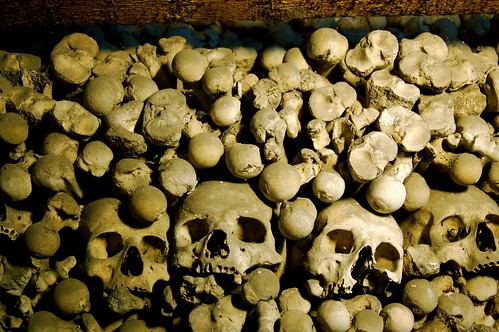
What probably captures our attention most of all in the first reading is the incredible transformation brought about by the power of God’s Word. A valley full of dry bones becomes populated by an immense army. The dead are brought back to life. And what’s even more amazing is that God promises to do the same for the whole House of Israel. God promises to raise them from their graves to the fullness of life. Even so, we may perhaps pause to consider how God chooses to effect this startling transformation through the ministry of Ezekiel. Imagine for a moment what it might have been like to stand in the shoes of the prophet. How might he have felt as he gazed upon that desolate valley reeking with the smell of death? What might have been his initial reaction upon hearing God’s instruction to prophesy to the bones? Speaking to the dead? Could one conceive of anything more futile than that? And yet, the prophet obeys. He trusts in the power of God’s Word, and of the breath of God’s Spirit. He prophesies. And the dead are brought back to life.

We find something of the same defiant hope in Jesus’ exchange with the lawyer in the gospel. Although what Jesus encounters is not quiet a valley of bones, we might be forgiven for making a connection between the scene from the first reading and the dry cynicism of the one who questions the Lord. Could anything be more futile than to converse with someone who seems out only to criticize? And yet, Jesus does not shrink from the encounter. Instead, he uses the opportunity to present an invaluable teaching: the greatest and first commandment.

Which brings us to Mary. For who is Jesus but the Word of the Father? And how does the Father choose to speak this Word except through the generous consent of Mary. Like Ezekiel, relying upon the breath of the Holy Spirit, Mary courageous speaks the Father’s Word of Life over the dry bones of the human race. As futile a project as it may have seemed, and as costly a sacrifice as it might have involved, Mary did not flinch. She spoke. And we were brought back to life. Isn’t this reason enough to proclaim her as our Queen? And not just to proclaim, but also to beg her to obtain for us the same defiant hope that she had. So that even in the face of apparently futile situations – both around and within us – we will yet find the courage to prophesy. As children of so wonderful a Mother, as subjects of so splendid a Queen, can we do anything less?

How, and in what situations, are we being invited to prophesy today?

Thursday, August 21, 2008


Thursday in the 20th Week of Ordinary Time
Memorial of St. Pius X, Pope
Beyond Hand-Washing


Readings: Ezekiel 36:23-28; Psalm 51:12-13, 14-15, 18-19; Matthew 22:1-14
Picture: CC aka Kath

In the movie, As Good As It Gets, Jack Nicholson’s character suffers from obsessive-compulsive disorder. It’s a debilitating condition in that it forces him to do various things in highly ritualized and rigid fashion. The simple act of washing his hands, for example, takes incredibly long, because he has to do it a certain way and a definite number of times, each time replacing the soap in a particular position, and so on. In a memorable scene, Nicholson wants very much to take his beloved out to dinner. But he almost ruins everything by making his date wait an eternity for him, while he showers in the bathroom. It’s quite ironic, isn’t it, how obsessing over getting clean – over preparing oneself for something – can actually hinder us from truly enjoying the main event?

Sometimes I wonder if the same might not be said about the way we live our religious lives. We know how important it is to have clean hands and pure hearts. Often, much of our spiritual energies are spent trying to keep ourselves away from the filth of sin. And this is probably as it should be. Indeed a large part of our readings today is all about how God promises to cleanse God’s people. I will give you a new heart and place a new spirit within you… you shall be my people and I shall be your God.

But there are also other important points to note. First, the readings are less about the people keeping themselves clean (try as they might, they seem quite powerless in this respect) than about how God purifies the people. And second, cleansing appears only as a part – albeit a significant and important part – of the message in our readings. There is also something more. Could it be that some, if not many of us, often obsess so much over trying to keep ourselves clean that we end up hardening the very hearts that God promises to soften? Could it be that we pay so much attention to spiritual cleanliness that we end up neglecting the other just as important aspects of the message?

The gospel presents us with two of these aspects. Jesus’ parable highlights the point that in addition to cleansing us, God also calls us to enjoy the joyful fellowship with God and one another. It’s probably true that our preoccupation with our many secular activities is the main reason for our reluctance to take up God’s generous invitation. But one may also wonder whether, at least sometimes, our obsession with our own sinfulness could have the same effect. Such obsessions can keep our attention focused more on ourselves than on the mercy of God.

In addition, our efforts at staying away from sin can also make us neglect the third important aspect in our readings today. Not only does God cleanse and call us, but God also expects us to allow ourselves to be clothed with the wedding garment that is the life, death and resurrection of Christ. It is only in putting on Christ, in striving to live the life that he lived, in immersing ourselves ever more fully in the challenges of daily human living, that we can truly be kept clean from the stain of sin and selfishness. Could it be that, instead of remaining perpetually obsessed with washing our own hands, it is precisely only in trying to hear and heed God’s call and in allowing ourselves to be clothed in Christ, that we are cleansed?

How might God be calling and choosing us to go beyond our obsession with cleanliness today?

Wednesday, August 20, 2008


Wednesday in the 20th Week of Ordinary Time
Memorial of St. Bernard, Abbot & Doctor of the Church
Muscle Building


Readings: Ezekiel 34:1-11; Psalm 23:1-3a, 3b-4, 5, ; Matthew 20:1-16
Picture: CC phil dowsing

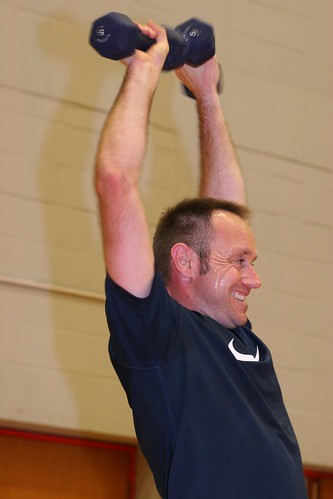
Following from yesterday’s fitness analogy, we might begin our reflection today by considering some facts that underlie our need for physical exercise. Muscles are made to be used. They grow only to the extent that they are exercised. Left dormant for too long, muscles will begin to weaken and waste away. On the other hand, however, they shouldn’t be overworked. Muscles also need enough time for rest and recuperation. Otherwise they will not grow. A right balance of work and rest, therefore, is essential to any good exercise program. In addition, it’s also important to consider how muscles work. Simplistically put, they act like rubber bands that hold together and move various bones or body parts across joints. And, what enables them to do this effectively, are the tendons that connect the muscle to the bones with which it is associated. A torn tendon will not only render the muscle useless but it can also cause excruciating pain.

Why, we may wonder, are we talking about muscles today, when our readings invite us to consider the difference between good and bad shepherds? The connection becomes a little clearer, when we consider Jesus’ description of the Kingdom of heaven in the gospel. When we think of the Good Shepherd, it’s not unlikely that we find ourselves imagining rest along flowing waters and relaxation in green pastures. Indeed, the Good Shepherd Psalm (23) does paint just such a scene for us. And we often associate this same image with eternal rest. Quite appropriately, we sing this psalm at funerals and wakes. Even so, our gospel today invites us to consider how the Divine Shepherd is also a Vineyard Owner, who seems to delight in putting the sheep to work. Could it be that part of being a Good Shepherd is also to find work for the sheep? Could it be that a shepherd can actually do harm by expecting too little from those under his/her care? Could it be that sheep actually need to work? Could it be that, like muscles, they will also waste away if left idle for too long?

This is, of course, a dangerous consideration for us to make. It’s dangerous because we tend towards the other extreme. Is it not risky to speak of work to a nation of workaholics? And yet, isn’t it also true that our busy-ness with secular activities often goes hand-in-hand with a tendency to think of religion only in terms of (eternal) rest? Isn’t this why our faith often seems so divorced from our daily living? Isn’t this why we often turn to God only in times of major crisis or extreme fatigue? Isn’t this why it’s so difficult for us to find the proper balance between labor and leisure?

Perhaps what we need is to consider our work and its meaning in a new light, and within a new context. The dignity of human work – or the human who works (homo faber) – consists in its marking of the earth with the imprint of the human and the divine, in its connecting of the heavenly with the earthly. Our work is meant to somehow make God more present to the world. And, like muscles, we attain this lofty aim only to the extent that we are firmly inserted, at one end, in the will of God, and at the other end, in the needs of the world. (On the dignity of human work, see, e.g., JPII, Laborem exercens.)

And let us also not forget the key piece of good news in our readings today: that the generosity of our God goes beyond any earthly employer. When we work in God's vineyard, we never labor in vain. God rewards every little effort that we make, every little bit of exercise that we engage in.

How are we being invited to flex our muscles today?