Sunday, January 27, 2013


3rd Sunday in Ordinary Time (C)
Reviving the Drowning


Picture: cc Ofutt Air Force Base

Sisters and brothers, imagine for a moment someone suddenly experiencing difficulties while taking a dip in a swimming pool. Maybe s/he develops a muscle cramp. Or maybe s/he just doesn’t swim very well. Whatever the reason, the person starts to struggle in the water. Finds it difficult to stay afloat. And, after some time, the struggling gets weaker and weaker. The person begins to drown.

Thankfully, an alert lifeguard sees what’s happening, dives into the pool, and pulls the person out. But s/he has already stopped breathing. The body has already started to shut down. The lifeguard immediately begins administering CPR. Blowing life-giving air into the person’s mouth. Compressing the person’s chest. And, as this is being done, a small group of people start to gather. Maybe they’re curious. Or perhaps they’re genuinely concerned for the survival of their fellow-swimmer. They want to see if the lifeguard will succeed. Or if it is already too late. Will the unconscious swimmer be revived? Will the motionless body be resuscitated? Will the drowning person once more draw breath?

Crucial questions surrounding a rescue mission. Isn’t this also what we find in our Mass readings today? In each of our readings, there are drowning people requiring resuscitation. People on whom a lifeguard is performing CPR. With varying degrees of success. The first reading, as you know, is set in a time just after the return of the Israelites from exile in Babylon. God has rescued them from foreign oppression. And brought them back to their own land. But they are not completely out of danger yet. Having been away for so long, the people have forgotten the laws that God had given to their ancestors. Laws that helped earlier generations to live according to God’s ways. The people have been drowning in attitudes and habits that they picked up when living among pagan peoples, who worship foreign gods. Customs that are not always in line with the ways of God. The ways that lead to the fullness of life.

It is this same drowning people that the prophet Ezra gathers in the first reading. And it is on them that he performs CPR. He breathes the breath of life into them by reading and explaining to them the Law of God. For, as we declared just now, in the response to today’s psalm, your words, Lord, are spirit, and they are life. The Word of God is, for us, the Breath of Life. And, thankfully, Ezra’s rescue mission has a happy ending. The people welcome the breath of God’s Word into their hearts. And they begin to come alive. They are moved by what they hear. They even shed tears. And Ezra continues to revive them by reminding them to focus not so much on their own sins, as much as on God’s mercy. They are to stop drowning in their own sorrow. But instead to remember all the wonderful things God has been doing for them. To rejoice in the goodness of the Lord. For the joy of the Lord is your stronghold.

We see something similar happening in the gospel as well. In Luke’s gospel, Jesus begins his public ministry by entering the synagogue in his hometown and preaching the Good News to the people there. Using a passage from the prophet Isaiah, Jesus describes what he is doing in terms of a rescue mission. The spirit of the Lord has been given to me, he says. He has sent me to bring the good news to the poor, to proclaim liberty to captives and to the blind new sight, to set the downtrodden free.

To a people imprisoned by many religious obligations that do not seem to bring them any closer to God, Jesus offers liberation. To a people unable to see and to recognise God’s presence in their daily lives, Jesus offers new sight. Into the cold hearts of drowning people, Jesus breathes a new breath of life. Which is nothing other than the breath of the Spirit of God. A breath that brings freedom and the fullness of life. Unfortunately, however, Jesus is not as well received as Ezra was. As we will see in next Sunday’s gospel reading, the people refuse to be revived. They take offence at what Jesus tells them. So angry are they with their Lifeguard from Heaven that they even try to kill him.

In the second reading too, we find a people drowning in some way. As you know the Christian community in Corinth was blessed with many different spiritual gifts. Gifts of praying in tongues, for example, of speaking words of prophecy, of healing and teaching, and so on. But the people place such great emphasis on their individual giftedness that they lose sight of God, the Giver of every good gift. They use their different talents in ways that divide the community. In ways that bring death and destruction. Instead of life and freedom. In the second reading, Paul is writing to a people drowning in their own arrogance and overblown sense of self-importance.

It is into this people that Paul breathes God’s Word of Life. Paul reminds them that they should be exercising their gifts not to inflate their own egos, but rather to build up the Body of Christ, of which they are all members. You together are Christ’s Body, he tells them, but each of you is a different part of it. What the reading leaves unclear is how receptive are the Corinthians to Paul’s efforts at spiritual CPR. Will they choose to accept the Spirit of life and of freedom? And to expel the spirit of division and death? Will they let themselves be revived by God’s Word?

Sisters and brothers, I don’t know the answers to these questions. But perhaps it’s less important for us to inquire about the Corinthians than it is to ask about ourselves. For whether we care to admit it or not, like the people in each of our readings, we too live in constant danger of spiritual drowning. Perhaps there are some of us here this morning who feel as though they are struggling to stay afloat. If you are among those who feel this way, then our readings offer you good news. In this Mass, as you listen to God’s Word, and eat at God’s table, God is breathing into you a breath of new life. Reminding you of God’s undying love and concern for us. Encouraging you to persevere in living according to God’s ways.

And perhaps there may also be those among us who are in danger of drowning without even realising it. Drowning, for example, in the often superficial and empty busyness of our daily routines. Such that we are unable to recognise and respond to the God who comes to meet us in the people and the situations we encounter everyday. The God who continues to call us to a deeper relationship. Drowning in our obsession with building our careers and inflating our egos. Such that we fail to notice the many people around us who may need our help. Drowning in the many gifts we have received from God without being sufficiently grateful for them. Without trying to share them with others in some way.

Whatever may be our situation today, God our Divine Lifeguard wishes to breathe into us the Breath of the Spirit. The Breath of love and compassion. The Breath of freedom and of fullness of life. The question for us, sisters and brothers, is how ready are we to be revived from drowning today?

Sunday, January 13, 2013


Feast of the Baptism of the Lord
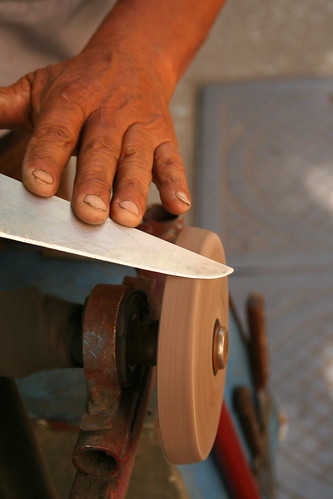
Sharpening the Word

Picture: cc _P_

Sisters and brothers, have you ever noticed the similarities between a knife in the hand and a word from the mouth? What do you do, for example, when you need to sharpen a knife? And how do you tell whether or not it’s sharp enough? I found the answer to these questions the other day, while watching Top Chef. You know that TV show that features a group of chefs taking part in a cooking competition. On that particular episode of the show, each of the chefs had to sharpen a blunt knife on a sharpening stone as quickly as possible. And they had to keep sharpening until their knives were so sharp they could slice a sheet of paper with a single stroke. A sharpening stone. And the slicing of paper. That’s how you can develop and discern a sharp knife.

Words are no different. We’ve all probably felt the effects of a sharp word. Perhaps we know someone–maybe a colleague, or a friend, or a relative–who has that frightening ability to cut through us with nothing more than a few carefully chosen words. We know from experience that words can have an effect very similar to that of a knife. A sharp knife can slice paper. A sharp word can pierce the heart. And the similarity doesn’t end there either. A knife becomes sharp by being repeatedly drawn across the hard surface of a sharpening stone. Sharp words are developed, very often, when a person is forced to endure hardship of some kind. When someone is brought into close contact with certain harsh realities of life. A hard life. And the piercing of the heart. That’s how a sharp word is developed and discerned.

But is this all that knives and words have in common? What about the fact that a sharp knife can be used also for a very good purpose. Even a very tasty and delicious purpose. On Top Chef, for example, those knives that the chefs sharpened were used not only for cutting paper, but also to prepare mouthwatering dishes of food. The knives were used to build up. Not just to destroy. And sharp words can do the same too, can’t they?

Of course they can. Isn’t this what we find in our Mass readings today? In the first reading, God wishes to speak a word that has precisely this delicious effect. The effect of building people up, instead of destroying them. Of comforting, instead of causing pain. ‘Console my people, console them’ says your God. ‘Speak to the heart of Jerusalem and call to her. This desire of God to speak a sharp word of solace to us, a word capable of penetrating our hardened hearts, comes to fulfilment at Christmas. At Christmas, the Word of God becomes flesh. For in order for this Word to penetrate our hearts, it has first to be sharpened. Sharpened by being drawn into the harsh realities of human life. By being brought up against the hard surface of human weakness and sin.

And this process of sharpening is exactly what we see happening in the gospel today. For why did Jesus submit to the baptism of John? John’s baptism was one of repentance for the forgiveness of sins. But Jesus had no sins for which to seek forgiveness. He had no need to repent. Why then did he choose to begin his public ministry by allowing John to lead him into the waters of repentance? In the first volume of his book, Jesus of Nazareth, Pope Benedict XVI tells us that the Baptism of the Lord was not so much an act of repentance of sin as an expression of solidarity with sinners. According to the Pope, by his baptism, Jesus loaded the burden of all mankind’s guilt upon his shoulders; he bore it down into the depths of the Jordan. He inaugurated his public activity by stepping into the place of sinners (p. 18).

In other words, like a knife being ground on a solid sharpening stone, in his baptism, Jesus the Word of God allows himself to be drawn up against the rough and hardened surface of our sinfulness. Why? So that he might better fulfil the wish of His Father in Heaven to speak a healing word to His people. So that Jesus, the eternal Word of God, might truly be made sharp enough to penetrate the hardness of human hearts. The hardness of our hearts. Yours and mine. And to penetrate us not in order to condemn. But to comfort and to console. To touch and to transform.

Isn’t this also what Paul is talking about in the second reading? When the kindness and love of God our saviour for mankind were revealed, Paul writes, it was not because he was concerned with any righteous actions we might have done ourselves; it was for no reason except his own compassion that he saved us. And isn’t this also why God the Father expresses such delight over Jesus after his baptism? You are my Son, the Beloved; my favour rests on you. Just as a top chef might favour a sharp knife, so too does the heavenly Father delight in the penetrating Word who is his Son. For, with this sharp Word, the Father can now speak to our wayward hearts. The better to call us back to His side. To transform us from strangers and enemies into beloved sons and daughters.

This then, sisters and brothers, is what we are celebrating on this feast day of the Baptism of the Lord. Today, we rejoice that Jesus our Saviour has seen fit to share in the weakness of our human condition. Today we feast our eyes on the sight of the Word of God submitting himself to being sharpened in order to save us. Today, we open wide our ears and our hearts to listen closely to the Word of God as he speaks to us the words that we need to hear. The words that comfort and heal and transform. The words that proclaim that we too are beloved children of God. That we too find favour in God’s sight.

But that’s not all. As we celebrate the Lord’s baptism, our readings remind us also of our own baptism. Today, we remember also how God has saved us by immersing us in the cleansing water of rebirth and by renewing us with the Holy Spirit which he has so generously poured over us through Jesus Christ our saviour. Today, we recall how we too are called to follow the example of Christ. To allow ourselves to be sharpened by contact with the hardships of human life. Hardships of our own surely. But also hardships of those far less fortunate than we are. Hardships of those who continue to struggle to shelter and to feed themselves and their families. Hardships of those who are lonely and depressed. Those who can’t seem to find any meaning to their life here on earth. Today, we commit ourselves to continuing to allow God not just to save us, but also to sharpen us. So that, like Jesus, we too can learn to speak words of comfort and consolation. Words capable of touching and transforming our world.

Sisters and brothers, on this feast of the Baptism of the Lord how ready are we to allow God to sharpen us today?

Sunday, January 06, 2013


Solemnity of the Epiphany of the Lord
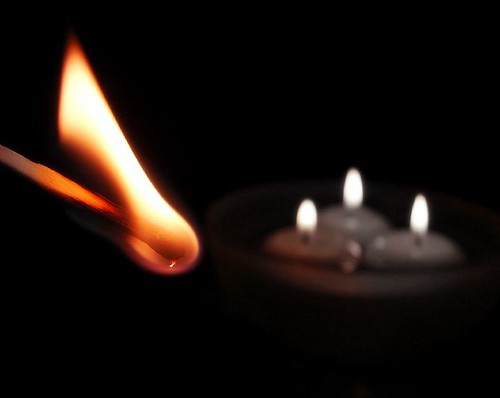
A Candle’s Choice

Picture: cc aussiegall

Sisters and brothers, some of you may still remember those 5 candles that were part of the Advent wreath placed in our sanctuary in the weeks leading up to Christmas. There was a white one, a pink one, and 3 purple ones. Do you perhaps wonder where these candles are now? Or what they look like? Very likely, wherever they are, they look far less pretty than they did before we set them alight. By now, their wicks, which were once so soft and white, will have become blackened and stiff. The tall elegant wax columns melted and misshapen. How do you think these candles are feeling now, if they could feel? And, if a new candle were to see what has happened to these used ones, what do you think the unused candle will say, if it could talk? What will it do, if it could move or walk?

I’m not sure, but I think there are at least two possible reactions. The first is that of fear. Having seen the terrible effects of fire on its friends, a new candle might say: Never! This will never happen to me! It may try its best to protect itself. To avoid ever being set alight. It may run away whenever a flame approaches. Or even try to put the fire out. Anything to avoid disfiguring its sleek solid body. In other words, the candle will be making a choice. It will choose to preserve its wax, rather than to submit to the flame. And, if it’s a smart candle, it might even find some way to make its wax increase. To make it grow so thick and so tall, that the wick is completely enclosed within. No longer exposed to the open air. Making it all the more difficult for someone to set the candle alight.

But it’s also possible that another new candle might have an opposite reaction. Not fear, but desire. Even after having seen and spoken to candles that have been used and discarded, a new candle might actually still want to be set alight. Why? Perhaps because such a candle realises that the whole reason for its existence is to be consumed by fire. So as to give light to those who live in the dark. Perhaps such a candle might have felt the strange inner emptiness, the curious restlessness, that comes with remaining pretty and elegant, but unused and unlit. So that, in contrast to the first candle–the one gripped by fear–this second one may eagerly go out of its way to look for the fire. To expose itself to the heat. To allow its wax to be consumed by the flame.

Fear and desire. Wax and flame. Two possible reactions. Two different choices that candles can make when facing the fire. And these too are also the reactions and choices that we find in our Mass readings today. As you know, the solemn feast of the Epiphany of the Lord is an important part of our celebration of Christmas. A celebration of how Christ our Light comes among us to enlighten not just the people of Israel, but the whole human race. As the second reading tells us, pagans now share the same inheritance... they are parts of the same body, and... the same promise has been made to them, in Jesus Christ. Or, in the words of our response to the psalm: all nations shall fall prostrate before you, O Lord.

But in order for the Light of Christ to spread to all people. those on whom it is already shining need to do what Jerusalem is being asked to do in the first reading. Arise, shine out, for your light has come, the glory of the Lord is rising on you… Like a candle that’s about to be set alight, all those on whom the light of Christ is already shining are being asked to submit themselves, in some way, to the flame. To allow themselves to burn. So that those who are still living in shadow might see and enjoy and be guided by the Light.

This invitation, however, is not easy to accept. It’s difficult, because there is a price that must be paid. A sacrifice that must be made. And not all are willing to pay the price. Not all are willing to make the sacrifice. Isn’t this what we find in the gospel? Notice what happens when a mysterious star begins to shine in the sky. The light from this heavenly flame provokes two contrasting reactions. On the one hand, not only are the wise men from the East filled with delight, they also take the trouble to drop whatever they’re doing and to travel a long distance, just to come close to the Light. They even spare no expense. They’re willing to give away their most precious possessions. And we may imagine that, having been set alight by their encounter with the baby Jesus, they return to their own country to share this same Light with all whom they meet. With all who may still be walking in the dark. Like the second candle we spoke about earlier, these wise men are willing to sacrifice the wax of their comfort and their material possessions. They’re eager to submit to Christ, the love and light of the Father. Christ, the divine yet human Flame.

King Herod, on the other hand, reacts very differently. In the gospel, we’re told that when the king receives news of the star’s appearance, he is perturbed. Not delighted, but disturbed. Disturbed because it was believed that a new star indicates the coming of a new king. And if a new king was coming, what was to become of the old one? Of Herod himself? To welcome the new king, the old one will have to give up his kingship. Much like a candle has to let go of its wax in the face of an approaching flame. But Herod is not willing to make the sacrifice. He refuses to pay the price. So he plots instead to have the child murdered. He goes all out to snuff out the Flame.

Delight and disturbance. Eager self-sacrifice and anxious self-preservation. These are the reactions that were provoked, the choices that were made, when the Light of Christ came into the world for the first time. And aren’t these still the reactions and the choices that remain open to us, sisters and brothers, even as the Light of Christ continues to enter into our world, and to shine upon our lives today?

Self-sacrifice or self-preservation. Isn’t this the choice that presents itself when, for example, crowded conditions and apparently diminishing job prospects lead a nation of immigrants to frown upon the many newcomers looking for a better life? To discriminate against them, and to treat them badly? Self-emptying sacrifice or self-serving ambition. Isn’t this the choice that presents itself too when career-minded people are suddenly led to see that their obsession with accumulating worldly possessions, and with achieving earthly success, is taking a serious toll not only on their own physical, mental and spiritual health, but also on the wellbeing of their families and communities?

Sisters and brothers, on this solemn feast of the Epiphany of the Lord, much like a burning match might approach an unused candle, the Light of Christ continues to draw near to us. How ready are we to submit to its fire? How willing are we to be set alight by its flame today?

Saturday, December 29, 2012


Feast of the Holy Family
Family Pictures on a Touchscreen

Picture: cc exfordy

Sisters and brothers, have you ever marvelled at the things you can do with a touchscreen? The kind that we find on a smartphone, an IPad or a tablet PC? I myself don’t use a touchscreen on a regular basis, but I’ve watched other people do so. And I’ve been fascinated. One moment you’re looking at a vivid image on the screen. And then, with a tap of a finger you can make the screen display a completely new and different picture. Or, you can remain with the same picture but, using your thumb and forefinger, you can make it bigger, or smaller. You can even make the screen display different parts of the same image. You can zoom in to focus on something in a corner, for example. Or zoom out to see more of the background.

Those of us who enjoy the luxury of playing with these devices on a daily basis probably don’t even think twice about it. But isn’t it a truly marvellous thing to be able to do all this? To change the way an image is displayed by simply touching the screen with a finger? And I’m not thinking only about the technology involved. Although it must be very interesting. What I find even more amazing is what such a device can do for us. Whether we realise it or not, the touchscreen gives us the power to look at a given thing–to look at life itself, really–from many different angles. To see familiar things in new and surprising ways. So that we can appreciate reality more deeply. And, hopefully, live life more fully.

I mention this because I think that our Mass readings for today do for us something very similar. Just as a touchscreen can help us to see ordinary things from fresh perspectives, so do our Mass readings display for us new ways of looking at something that we may think we already understand very well. What images come to your mind, for example, when you think of family? Where do families come from? What are they for? What does it feel like to live in a good family? Image and origin, purpose and feeling. These are some of the questions concerning family life that our readings help us to answer today.

I’m not sure, sisters and brothers, but I think that probably the first image that comes to most of ours minds when we think of a family is that of parents and children, and perhaps grandparents, all living together in the same household. And along with this image of the family, we also have a common view of how families come about. Their origin. We tend to think that families originate first from a decision that people make for themselves. We say, for example, that so and so is starting a family. As if a family is something that one can start at will. And if someone else decides to remain unmarried, we tend to think that such a person has no family of his or her own. And yet, when we turn to the images displayed on the touchscreen of our readings today, we get a rather different perspective.

Consider the story of Hannah in the first reading. Notice how, for long years, she had wanted a child of her own, but was unable to conceive. Much as she wanted to start a family, she could not. It was only after she had gone to pray at the Temple in Jerusalem that she finally gave birth to a baby boy. Whom she named Samuel. What does this tell us, sisters and brothers, if not that a family is not first of all something that one starts for oneself? A decision that one makes. A family is rather a precious gift that one receives from God. God is the Origin of family life.

Isn’t this why, immediately after Samuel is weaned–when he is old enough to survive apart from his mother–Hannah brings him to the Temple and dedicates him to the service of the Lord for his whole life? For Hannah, the child was a gift from God. So, he should live his life for God. But not only that, Hannah’s dedication of Samuel also implies a much broader image of family life than one that consists only of parents and their children. For if God is the child’s proper Origin, then the People of God are his proper family. And Samuel’s service in the Temple of God can properly be considered family service.

The second reading presents us with a similar picture, when it invites us to think of the love that the Father has lavished upon us by letting us be called God’s children. More than just children of our earthly parents, we are all children of God. And, as members of God’s family, we are all to love one another. To live our lives in service of each other. Whatever may be the colour of our skins, or the countries of our birth, or the languages we speak.

The second reading also goes on to indicate to us the purpose of family life as seen from this broader perspective. After telling us to love one another as Christ told us to, the reading goes on to say that whoever keeps his commandments lives in God and God lives in him. More than just generating and nurturing children–as important as this is–family life is ultimately about living in God. Living in God by living in the love that God has shown us in Christ Jesus our Lord. The love that led Jesus to be born for us in a manger. The love that saw him give his life for us on the Cross. The same love that we celebrate at this and at every Eucharist.

And yet, this broad view of family life should not lead us to think poorly of our own immediate families. Much less to take them for granted. For many of us–though by no means all–living a life of love, living a life in God, will usually mean living together with particular members of an immediate family. With spouse, parents, grandparents, children, sisters and brothers. And living such a life means caring for specific members of such a family. Which leads us to the final question that our readings help us to answer today. What should it feel like to live a good family life?

The gospel provides us with an answer that is probably quite surprising. For it’s likely that we may think of life in a good family as being one that’s free from tension. As being more or less plain sailing all the way. And yet, tension is precisely what we find in the gospel. Here both Jesus and his earthly parents struggle to negotiate the tension between the obligations of the immediate family and those of the family of God. As the son of Mary and Joseph, Jesus really should have informed them of his intention to remain in the Temple. Just as it was only proper–at least at this stage of his life–that he should return with them to Nazareth and live under their authority. And yet, as Son of his Father in Heaven, it was also proper that he should be busy with his Father’s affairs. What is this sisters and brothers if not tension? But a healthy tension. A necessary tension. For we are told that, living in this way, Jesus increased in wisdom, in stature, and in favour with God and men. It was precisely their willingness to live this tension courageously that made Jesus, Mary and Joseph a Holy Family.

This then, sisters and brothers, is what family looks like when seen through the eyes of faith. This is the image of family life displayed on the touchscreen of our readings. Sisters and brothers, how ready are we to allow our hearts to be touched by this image? How willing are we to live the reality of family life in God today?

Wednesday, December 26, 2012


Christmas Day (Mass during the Day)
Words That Hurt & The Word That Heals


Sticks and stones may break my bones, but words will never hurt me.

Sisters and brothers, I think you’ve probably heard this maxim before. It’s what parents used to teach their children to say when teased by their friends. Words will never hurt me. A very brave statement to make, don’t you think? It seems to imply that words don’t matter very much. And yet, we all know, from experience, the power that words have over us. Anyone who’s ever opened a rejection letter, for example, turning down their application for a much needed job, or to a much sought after school, will know the power of words to sadden and to disappoint us.

And words can do much worse than that. Some of us will remember, for example, the tragic story of Amanda Todd, the 15 year-old Canadian girl, who took her own life just a couple of months ago, after being cruelly bullied on Facebook. Or perhaps some of us may know first hand what it feels like to be a victim of character assassination. Having others gossip about us. Or spread rumours concerning us. Whether true or not. Demolishing our reputations or even our careers in the process. Clearly, not only can words disappoint, they can also destroy.

And those are just the more obvious effects. There are also more subtle but no less dangerous ones. Not only can words disappoint and destroy, they can also deceive and seduce. Mislead and confuse. How many of us, for example, can deny being continually enticed by cunning advertisers into buying things that we do not really need? And on a regular basis? How many of us can say that we have not been led to believe, by society at large, that our worth as persons depends mainly upon the highs and lows of our successes and failures. Upon the make of car that we drive, or the district in which we live. Upon the kind of work we do, or the company we keep. Upon the school to which we send our kids, or the grades those same kids obtain. How many of us can claim to be unaffected by the words that may pop into our minds from time to time, telling us we’re worthless. Or just not good enough. Discouraging us from persevering in whatever worthwhile thing we may be trying to do.

Sisters and brothers, whether we care to admit it or not, words do have power over us. Power to disappoint and to destroy. To seduce and to mislead. To discourage and to depress. But if this is true, what becomes of our beloved maxim then? Sticks and stones may break my bones, but words can never hurt me. Are parents expecting too much from their children when they teach them to say this? Is it just a matter of wishful thinking? Of putting up a brave front. If words are indeed so powerful, how can we expect not to be hurt by them?

And yet, perhaps the maxim doesn’t really mean that words do not have power over us. They do. Obviously. But rather, as powerful as words may be, perhaps it remains possible for us to tune them out. The way people tune a radio, for example. Or switch channels on a TV set. We can tune out the hurtful and misleading words by tuning in to healing and nurturing ones. Isn’t this how parents can help to protect their children from the cruel and confusing words of others? By constantly speaking loving and nurturing words themselves. Words of guidance and of truth. And words that are not just being spoken, but also constantly being translated into action. Into quality time spent with the child, for example. And into close attention being paid to its needs and concerns. Such that, held secure in their parents’ unconditional love and acceptance, the child is better able to disregard whatever hurtful things others may say about it.

Isn’t this also what our God, our divine Parent does for us? Isn’t this what we celebrate at Christmas? The wonderful mystery of our heavenly Father speaking to us in a remarkably new and compelling way.  Reminding us of how much we are loved and cherished. Showing us the way to true happiness. As the second reading tells us: At various times in the past and in various different ways, God spoke to our ancestors through the prophets; but in our own time, the last days, he has spoken to us through his Son. His Son Jesus, who, the gospel tells us, is also the eternal Word of God. At Christmas, we celebrate how this same Word of God becomes translated into terms that we can better experience and understand. Into a living breathing human person, whom we can see and touch. The Word was made flesh, he lived among us, and we saw his glory.

But that’s not all. As the Word of God comes among us, he also brings much power. The power to save us from our enemies. From the hurtful and misleading words that threaten to lead us astray. In the first reading, this salvation comes in the form of the joyful news that God is fighting on behalf of his people. For the Lord is consoling his people, redeeming Jerusalem. The Lord bares his holy arm in the sight of all the nations. And this should not be surprising. For this is what the Word of God is all about. As the gospel tells us, the Word of God is both light and life. He enlightens all people. Shows them the way to true happiness. And to those who receive his message, those who accept him into their hearts and into their lives, the Word gives power to become children of God. Power to live life to the full.

Isn’t this what Christmas is really about? It is about a loving Father continuing to speak his Word to his children. His Word of Love and Light and Life. And even translating this Word into a human person, able to lay down his life for his friends. Helping them to protect themselves against the effects of other words. Dangerous words. Words that seduce and discourage and destroy.

Sisters and brothers, perhaps it is true that while sticks and stones may break our bones, words will never hurt us. But only provided we learn to tune out these same words of danger and tune in to the Word of God made flesh for us. The Word whose coming we celebrate at Christmas.

Sisters and brothers, which channel are you tuned into? Whose words are you listening to today?