Sunday, February 24, 2013


2nd Sunday in Lent (C)
When the Going Gets Tough

Readings: Genesis 15:5-12,17-18; Psalm 26:1,7-9,13-14; Philippians 3:17-4:1; Luke 9:28-36

When the going gets tough, the tough get going.

Sisters and brothers, I think we’re all probably familiar with this line. It tells us what tough people do when faced with challenging situations. What do the strong do when the going gets tough? Well, they get going. Of course, this doesn’t mean that they were standing still before. What it does mean is that, when they encounter difficult and demanding situations, tough people are able to increase their efforts. They somehow manage to raise their energy levels and push through. Much like how someone driving a car might switch to a more powerful gear to climb a steep slope. When the going gets tough, the tough get going.

Sounds simple enough in theory. But it’s not always easy to put into practice, is it? For one thing, it’s not always easy to locate the gear stick, let alone know how to switch gears. Also, it’s not always clear from where we are to find the energy we need to face life’s challenges. Especially if the routine of daily living has already tired us out completely. How do we actually get going when, for example, a cherished relationship breaks down despite our best efforts to salvage it? Or when multiple job applications get rejected. Or when the doctors say there is nothing more they can do to cure an illness. Or when enthusiastic attempts to help the poor and the oppressed seem to lead to nothing but disappointment and disillusionment. In these and other challenging situations, how does one go about hanging tough? How does one actually keep going?

These are among the questions that our Mass readings invite us to reflect upon today. For, although it may not be so obvious, the going is getting noticeably tougher for some of the people in our readings. When we meet him in the first reading, taken from the 15th chapter of the book of Genesis, Abram is on a journey that God had commanded him to make. In chapter 12, God had asked Abram to uproot his family from the comforts of home and to set out for a distant unknown place. And the journey up till now has not been easy. Wars have had to be fought. A close family unit has had to break up and go separate ways. And, above all, Abram and his wife remain childless. What are they to do? How are they to survive this long difficult journey into the unknown without an heir to carry on the family name?

In the gospel too, the going is getting tougher for Jesus and his disciples. The reading is taken from verses 28-36 of the 9th chapter of Luke’s gospel. Immediately before this, in verses 21-27, Jesus had just told his disciples that he would soon have to undergo great suffering. He would be rejected, put to death, and then raised to life on the third day. Not only that, but Jesus had also made clear that the mark of a true disciple of his is the willingness to take up one’s own cross daily and follow him. For Jesus and his disciples the going is indeed getting very tough. Before them looms the steep and scary slope of suffering and death on the Cross.

And yet, as tough as it gets, neither Abram nor Jesus turn away from their respective journeys. Neither of them try to escape. They keep on going. How do they manage to do this? From where do they find the strength to press on? We discover their secret by considering three crucial changes that they undergo during this time of crisis. Changes that God leads each of them to make.

The first is a change in location. In the first reading, we’re told that God led Abram outside. And, in the gospel, Jesus leads Peter, James and John up the mountain to pray. Although these may seem like unimportant, inconsequential details, they really are very significant. For it is only because of their willingness to make this change in location that both Abram and Jesus are able to receive a renewed vision.

Having allowed God to lead him outside his tent, Abram is able to look up and gaze upon the countless number of stars twinkling in the night sky. And then to receive from God, the awesome promise that Abram’s descendants will be just as numerous. Similarly, having allowed himself to be led up the mountain, Jesus experiences a reassuring vision of the true meaning of all the terrible things he will soon have to endure. Although others may see him only as a condemned criminal or a religious heretic, Jesus is reminded that in undergoing his Passion, death and Resurrection he will be fulfilling both the Law and the Prophets. And that even if he may, at some point, feel that his heavenly Father has deserted him, Jesus is still the beloved Son, the Chosen One. To whom all must listen if they wish to find life.

And it is from this renewed vision of the future that both Abram and Jesus strengthen their resolve to continue walking the respective paths that God has marked out for them. Abram and his descendants to the Promised Land. And Jesus and his disciples to the Cross and beyond.

A change of location, leading to a renewed vision, and a strengthening of resolve. These are the three changes that Abram and Jesus undergo in our readings today. This is the secret to how they manage to find the courage to press on even in the face of formidable challenges. And isn’t this, sisters and brothers, also what we hope will happen to us in this season of Lent?

During this time of prayer and fasting and almsgiving, are we not also trying to change our location in some way? Although we may not actually step outside a tent, or climb a high mountain, we are trying to make an important shift. A shift between the two spiritual locations that Paul talks about in the second reading. The first location is where we find those behaving as the enemies of the cross of Christ. Those destined to be lost. Those who make their home only in earthly things. In contrast, the second location is where the true disciples of Christ are found. Those whose homeland is in heaven. And, in making this shift from preoccupation with earthly things to making heaven our homeland, we hope to receive a new vision of where God is leading us in our daily lives, so that we too may have the strength to follow Christ on the way of the Cross. And allow him to transfigure these wretched bodies of ours into copies of his glorious body.

When the going gets tough, the tough get going.

Sisters and brothers, on this 2nd Sunday of Lent, how might the Lord be keeping you going today?

Sunday, February 10, 2013


Chinese New Year
The Lesson of the Rooster in the Year of the Snake

Readings: Numbers 6:22-27; Psalm 90; James 4:13-15; Matthew 6:31-34
Picture: cc @mikepick

Sisters and brothers, once upon a time, there was a rooster who took himself very seriously. And there was a reason why this was so. You see, the rooster was blessed with a very powerful voice. A voice that he made sure to exercise everyday by crowing loudly at the break of dawn. And, having noticed how his crowing tended to coincide with the sunrise, the rooster thought that the sun actually rose only because of him. This made him very proud of himself. Even arrogant. Imagine. If not for him, the whole world would remain in darkness. So, he liked nothing better than to show off his crowing in front of others. He also took great care of his voice by regularly drinking ginseng tea mixed with honey and lemon. He even gathered some of the hens in his coop, and trained them very hard everyday, so that they could sing backup. To enhance the sound of his own voice.

But, as time went on, the rooster began to feel the pressure. If the whole world relied on him to make the sun to rise, then he couldn’t let everyone down. He had to be sure never to forget to crow early every morning. Even if he happened to have stayed out late the previous night. This sense of the heavy responsibility placed on his shoulders often made him anxious. It gave him many sleepless nights. All of which made the rooster rather miserable. Day after day, he usually found himself feeling either arrogant or anxious, or both. But hardly ever happy. And all because he thought that he was the one who made the sun to rise. All because he took himself far too seriously.

Then, one day, the unthinkable happened. The rooster got a sore throat. He lost his voice. Perhaps it was the durians he had eaten the day before. We cannot say for sure. Whatever the reason, he was unable to crow. But, as we might expect, the sun rose all the same. This made the rooster fall into a deep depression. He gave up crowing, and even left his home in the chicken coop. What’s the point of crowing, he thought, if it doesn’t actually cause the sun to rise?

The rooster’s sadness continued for a long time. Until one fateful afternoon, when he happened to hear a nightingale singing in a tree. It was such a beautiful sound that the rooster was moved to speak to the singer. He wanted to find out if its song actually made the sun to rise. Or the moon to shine. Or the stars to sparkle. But the nightingale shook its head and said, No. My singing does nothing of the sort. Then why do you bother? The rooster asked. To which the nightingale laughed and replied, Why not? It makes me happy! I sing not to cause the sun to rise, but to celebrate its rising. Not to cause the moon to shine, but to celebrate its shining. Not to cause the stars to sparkle, but to celebrate their sparkling! Hearing this reply, the rooster’s life was changed. He returned to the chicken coop and went back to doing many of the things he used to do. He resumed crowing. He also began to, once again, train and sing with his choir of chickens. But something was different. This time round, the rooster found himself being far less arrogant and anxious. At times, he even felt truly happy. All because, having realised that he didn’t cause the sun to rise, he was able to stop taking himself quite as seriously as he did before.

Now, you might wonder why, sisters and brothers, on this first day of the year of the snake, I have chosen to tell you a story about a rooster. The answer is simple. The lesson learned by the rooster is rather similar to the lesson that our Mass readings are trying to teach us today. Notice, for example, how the second reading warns us against presumption and arrogance. We are to be careful about taking our brief and fragile lives for granted. About planning too far ahead. For we never know what will happen tomorrow; we are no more than a mist that is here for a little while and then disappears. And notice too, how Jesus tells us, in the gospel, not to be anxious. Not to worry about what we are to eat, nor about what we are to drink. Not to worry about tomorrow, for tomorrow will take care of itself. Each day has enough troubles of its own.

Of course, if you are like me, you’ll find these warnings against arrogance and anxiety difficult to understand, let alone to put into practice. They are difficult to accept so long as we share the rooster’s mistaken assumption that we can actually cause the sun of our own survival and success to rise, solely by our own efforts. For, however capable and talented we are, however farsighted and well-prepared we may be, our efforts can only take us so far. Many things remain beyond our control. People can suddenly fall critically ill and die. Wars may break out. Natural disasters may occur. Stock markets can crash without warning. And these things will happen no matter how many sleepless nights we may choose to spend. Or however many white papers we may draw up and debate.

All this does not mean, of course, that we should not work hard. Or that we should not plan at all. Or that our efforts are unimportant. They are very important. As people say, those who fail to plan, plan to fail. Precautions have to be made. Responsibilities have to be borne. Work has to be done. But it makes all the difference in the world when we allow ourselves to accept that all these efforts of ours cannot actually ensure our survival and success. That our lives are not actually totally in our own hands.

It is only when we allow ourselves to humbly accept this truth, that we learn the importance of doing what Moses is learning to do in the first reading today. We learn to seek God’s help in all circumstances. We learn to entrust our wellbeing to the care and compassion of God at all times. We learn to keep praying that the almighty One–who could so easily sweep us away like grass which springs up in the morning and by evening withers and fades–will continue to bless us and keep us. Will ever uncover his face to us and bring us His peace.

And when we are able to entrust our lives into the hands of God in this way. When we are able to accept the truth that, however hard we may work, or however far ahead we may plan, we cannot actually cause the sun to rise. Perhaps we will also learn to take ourselves far less seriously. And, in so doing, learn to live the gift of life the way it is meant to be lived. As a joyous celebration, and not just a heavy burden. We may even experience, if only from time to time, what it feels like to be truly happy.

Sisters and brothers, as we usher in another new year, how might we let go of our arrogance and our anxiety? How might we learn to take ourselves a little less seriously?

Sisters and brothers, on this first day of the year of the snake, how is God teaching us the lesson of the rooster today?

Sunday, February 03, 2013


4th Sunday in Ordinary Time (C)
Putting One’s Foot in One’s Mouth

Picture: cc AshleyNYCPics

Sisters and brothers, are you familiar with the English idiom to put one’s foot in one’s mouth? As you know, this phrase doesn’t mean to actually try to find out what your own toes taste like. No. To put your foot in your mouth is to say the wrong thing. Something that goes against the grain. That embarrasses or shocks people. That offends or even scandalises others. Something that may even make you, the speaker, very unpopular. Which is why, in general, politicians try their best to avoid putting their foot in their mouth. Otherwise they may lose the support of their constituents, and be voted out of office. But, whether we are politicians or not, none of us likes to be caught putting our foot in our mouth. We know how painful and embarrassing it can be.

And yet, isn’t it true that, sometimes, it’s very important to be able to put one’s foot in one’s mouth? For example, in the story The Emperor’s New Clothes, a pair of swindlers tricks the emperor into believing that they have made him a suit of magical clothes. Clothes that cannot be seen by stupid people. Incompetent people. People unfit for their jobs. As a result, everybody pretends to be able to see the suit, even though it doesn’t exist. It’s only when an innocent little boy exclaims that the emperor is naked, that the scam is brought to light. At a time when everyone else was too afraid to look stupid, this little boy bravely proclaimed the truth. How did he save the emperor, sisters and brothers? By being willing to put his foot in his mouth.

All of which may help us to appreciate a little better, what our Mass readings are telling us today. As you may have noticed, the readings are all about what it means to be a prophet. Contrary to popular belief, a prophet is not just someone who is able to predict the future. A prophet is not a soothsayer or a fortune-teller. A prophet is primarily a spokesperson. Someone appointed by God to speak God’s word to others. So, in the first reading, God tells Jeremiah that God has consecrated him–has set him apart–even before he was born, to be God’s prophet to the nations. And, in the gospel, after reading from Isaiah, Jesus claims that the prophetic text is being fulfilled in him. Jesus identifies Himself as the One Whom God has appointed to bring the good news to the poor.

But our readings go even further. They invite us to reflect more deeply upon what it means to speak God’s Word to others. As it turns out, to be God’s spokesperson often means having to speak an unpopular word. An embarrassing word. Even a scandalising and upsetting word. This was certainly true of Jeremiah. When we read further on in the book of Jeremiah, we see just how unpopular was the message that God wanted him to proclaim. At a time when the Babylonian empire was growing in strength, and posing a serious military threat. At a time when many voices were calling for military alliances to be made, and military action to be taken, against Babylon. Jeremiah tried to persuade the people to submit. To let themselves be conquered. Even to allow their precious Temple to be destroyed. And they themselves to be sent into exile. Is it any wonder, then, that the people were so unhappy with Jeremiah that some even plotted to have him killed?

The situation in the gospel is similar. Perhaps one of the most striking things in the reading is the sudden shift in public perception of Jesus. When He first identifies himself as the Saviour that everyone is waiting for, we’re told that he won the approval of all. Not only that, but people immediately try to claim him as their own. This is Joseph’s son, surely? They exclaim. In other words, he is one of us. We know him. His achievements are our achievements. We can share in his glory. And it must have been so easy for Jesus simply to go along. To ride this wave of public approval. As any politician might.

But Jesus is the Prophet. Not a politician. His concern is not to win popularity, but to speak the Truth. He points out that it is not God’s intention simply to side with the people of Israel against their enemies. For God does not take sides in the way that we may expect. If anything, God sides not so much with Jew or Roman, but with all who are downtrodden and oppressed. Wherever and whomever they may be. As Jesus reminds the people, this is how God acted in the past. In a time of famine, when both Jews and Gentiles were starving, it was a Gentile that God sent Elijah to feed. A widow from Sidon. And, even though there were many lepers in Israel in the time of Elisha, it was Naaman, from Syria, that God sent the prophet to heal. This is how God operated in the great prophets of the past. And this is how God is operating in Jesus in the present. God’s mercy reaches beyond human boundaries to embrace all who may be suffering. All who may need God’s care and concern.

This, of course, is not a popular message to preach. It is not a politically astute position to take. So seriously does it scandalise the people, so upset are they, that they try to do to Jesus what their ancestors tried to do to Jeremiah. They try to kill him.

Clearly, sisters and brothers, to be a prophet is not an easy thing. It’s not easy because it often means having to put one’s foot in one’s mouth. And to do it on a regular basis. Even to make it a way of life. And yet this is what we too are called to be and do. You and I. We, who have been baptised in Christ, share His prophetic mission to speak the often unpopular, but always truthful Word. Which is why it’s important for us to pay close attention to the reassurance that God gives to Jeremiah in today’s first reading. Although it may be difficult and frightening to be a prophet, God promises to strengthen us. To make us into a fortified city, a pillar of iron, and a wall of bronze. And God does this by pouring into us the gift that Paul writes about so beautifully in the second reading. The gift of God’s love. The gift that comes to us in the one Sacrifice of Christ, which we have all gathered around this altar this evening to celebrate and to share.

This gift of love–as well as the gift of prophecy that it empowers–is something that our world needs more than ever. Today, we need people loving enough to speak the unexpected and unpopular word. People like Canadian journalist, Carl HonorĂ©, for example. In a world increasingly obsessed with speed, Carl has written a book In Praise of Slowness. Or people like American former-corporate lawyer, Susan Cain. In a world that tends to favour extroverts–people who crave continuous social connection–Susan has written a book entitled Quiet: The Power of Introverts in a World That Can't Stop Talking. Or, closer to home, people like Francis Yap. The father of Nigel and Donovan. The two brothers recently killed in a tragic accident in Tampines. At a time when others might curse and urge retaliation against the driver responsible for his sons’ deaths, Francis has this to say: Losing my sons, my heart is broken. Even if I hit, punch or scold him, my children can't come back…. as a Christian, I must learn to forgive.

Sisters and brothers, how is God calling us to speak the truthful word, and to live the prophetic call? How are we being invited, in some way, to put our foot in our mouth today?

Sunday, January 27, 2013


3rd Sunday in Ordinary Time (C)
Reviving the Drowning


Picture: cc Ofutt Air Force Base

Sisters and brothers, imagine for a moment someone suddenly experiencing difficulties while taking a dip in a swimming pool. Maybe s/he develops a muscle cramp. Or maybe s/he just doesn’t swim very well. Whatever the reason, the person starts to struggle in the water. Finds it difficult to stay afloat. And, after some time, the struggling gets weaker and weaker. The person begins to drown.

Thankfully, an alert lifeguard sees what’s happening, dives into the pool, and pulls the person out. But s/he has already stopped breathing. The body has already started to shut down. The lifeguard immediately begins administering CPR. Blowing life-giving air into the person’s mouth. Compressing the person’s chest. And, as this is being done, a small group of people start to gather. Maybe they’re curious. Or perhaps they’re genuinely concerned for the survival of their fellow-swimmer. They want to see if the lifeguard will succeed. Or if it is already too late. Will the unconscious swimmer be revived? Will the motionless body be resuscitated? Will the drowning person once more draw breath?

Crucial questions surrounding a rescue mission. Isn’t this also what we find in our Mass readings today? In each of our readings, there are drowning people requiring resuscitation. People on whom a lifeguard is performing CPR. With varying degrees of success. The first reading, as you know, is set in a time just after the return of the Israelites from exile in Babylon. God has rescued them from foreign oppression. And brought them back to their own land. But they are not completely out of danger yet. Having been away for so long, the people have forgotten the laws that God had given to their ancestors. Laws that helped earlier generations to live according to God’s ways. The people have been drowning in attitudes and habits that they picked up when living among pagan peoples, who worship foreign gods. Customs that are not always in line with the ways of God. The ways that lead to the fullness of life.

It is this same drowning people that the prophet Ezra gathers in the first reading. And it is on them that he performs CPR. He breathes the breath of life into them by reading and explaining to them the Law of God. For, as we declared just now, in the response to today’s psalm, your words, Lord, are spirit, and they are life. The Word of God is, for us, the Breath of Life. And, thankfully, Ezra’s rescue mission has a happy ending. The people welcome the breath of God’s Word into their hearts. And they begin to come alive. They are moved by what they hear. They even shed tears. And Ezra continues to revive them by reminding them to focus not so much on their own sins, as much as on God’s mercy. They are to stop drowning in their own sorrow. But instead to remember all the wonderful things God has been doing for them. To rejoice in the goodness of the Lord. For the joy of the Lord is your stronghold.

We see something similar happening in the gospel as well. In Luke’s gospel, Jesus begins his public ministry by entering the synagogue in his hometown and preaching the Good News to the people there. Using a passage from the prophet Isaiah, Jesus describes what he is doing in terms of a rescue mission. The spirit of the Lord has been given to me, he says. He has sent me to bring the good news to the poor, to proclaim liberty to captives and to the blind new sight, to set the downtrodden free.

To a people imprisoned by many religious obligations that do not seem to bring them any closer to God, Jesus offers liberation. To a people unable to see and to recognise God’s presence in their daily lives, Jesus offers new sight. Into the cold hearts of drowning people, Jesus breathes a new breath of life. Which is nothing other than the breath of the Spirit of God. A breath that brings freedom and the fullness of life. Unfortunately, however, Jesus is not as well received as Ezra was. As we will see in next Sunday’s gospel reading, the people refuse to be revived. They take offence at what Jesus tells them. So angry are they with their Lifeguard from Heaven that they even try to kill him.

In the second reading too, we find a people drowning in some way. As you know the Christian community in Corinth was blessed with many different spiritual gifts. Gifts of praying in tongues, for example, of speaking words of prophecy, of healing and teaching, and so on. But the people place such great emphasis on their individual giftedness that they lose sight of God, the Giver of every good gift. They use their different talents in ways that divide the community. In ways that bring death and destruction. Instead of life and freedom. In the second reading, Paul is writing to a people drowning in their own arrogance and overblown sense of self-importance.

It is into this people that Paul breathes God’s Word of Life. Paul reminds them that they should be exercising their gifts not to inflate their own egos, but rather to build up the Body of Christ, of which they are all members. You together are Christ’s Body, he tells them, but each of you is a different part of it. What the reading leaves unclear is how receptive are the Corinthians to Paul’s efforts at spiritual CPR. Will they choose to accept the Spirit of life and of freedom? And to expel the spirit of division and death? Will they let themselves be revived by God’s Word?

Sisters and brothers, I don’t know the answers to these questions. But perhaps it’s less important for us to inquire about the Corinthians than it is to ask about ourselves. For whether we care to admit it or not, like the people in each of our readings, we too live in constant danger of spiritual drowning. Perhaps there are some of us here this morning who feel as though they are struggling to stay afloat. If you are among those who feel this way, then our readings offer you good news. In this Mass, as you listen to God’s Word, and eat at God’s table, God is breathing into you a breath of new life. Reminding you of God’s undying love and concern for us. Encouraging you to persevere in living according to God’s ways.

And perhaps there may also be those among us who are in danger of drowning without even realising it. Drowning, for example, in the often superficial and empty busyness of our daily routines. Such that we are unable to recognise and respond to the God who comes to meet us in the people and the situations we encounter everyday. The God who continues to call us to a deeper relationship. Drowning in our obsession with building our careers and inflating our egos. Such that we fail to notice the many people around us who may need our help. Drowning in the many gifts we have received from God without being sufficiently grateful for them. Without trying to share them with others in some way.

Whatever may be our situation today, God our Divine Lifeguard wishes to breathe into us the Breath of the Spirit. The Breath of love and compassion. The Breath of freedom and of fullness of life. The question for us, sisters and brothers, is how ready are we to be revived from drowning today?

Sunday, January 13, 2013


Feast of the Baptism of the Lord
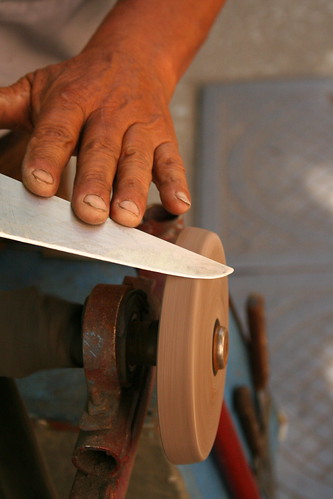
Sharpening the Word

Picture: cc _P_

Sisters and brothers, have you ever noticed the similarities between a knife in the hand and a word from the mouth? What do you do, for example, when you need to sharpen a knife? And how do you tell whether or not it’s sharp enough? I found the answer to these questions the other day, while watching Top Chef. You know that TV show that features a group of chefs taking part in a cooking competition. On that particular episode of the show, each of the chefs had to sharpen a blunt knife on a sharpening stone as quickly as possible. And they had to keep sharpening until their knives were so sharp they could slice a sheet of paper with a single stroke. A sharpening stone. And the slicing of paper. That’s how you can develop and discern a sharp knife.

Words are no different. We’ve all probably felt the effects of a sharp word. Perhaps we know someone–maybe a colleague, or a friend, or a relative–who has that frightening ability to cut through us with nothing more than a few carefully chosen words. We know from experience that words can have an effect very similar to that of a knife. A sharp knife can slice paper. A sharp word can pierce the heart. And the similarity doesn’t end there either. A knife becomes sharp by being repeatedly drawn across the hard surface of a sharpening stone. Sharp words are developed, very often, when a person is forced to endure hardship of some kind. When someone is brought into close contact with certain harsh realities of life. A hard life. And the piercing of the heart. That’s how a sharp word is developed and discerned.

But is this all that knives and words have in common? What about the fact that a sharp knife can be used also for a very good purpose. Even a very tasty and delicious purpose. On Top Chef, for example, those knives that the chefs sharpened were used not only for cutting paper, but also to prepare mouthwatering dishes of food. The knives were used to build up. Not just to destroy. And sharp words can do the same too, can’t they?

Of course they can. Isn’t this what we find in our Mass readings today? In the first reading, God wishes to speak a word that has precisely this delicious effect. The effect of building people up, instead of destroying them. Of comforting, instead of causing pain. ‘Console my people, console them’ says your God. ‘Speak to the heart of Jerusalem and call to her. This desire of God to speak a sharp word of solace to us, a word capable of penetrating our hardened hearts, comes to fulfilment at Christmas. At Christmas, the Word of God becomes flesh. For in order for this Word to penetrate our hearts, it has first to be sharpened. Sharpened by being drawn into the harsh realities of human life. By being brought up against the hard surface of human weakness and sin.

And this process of sharpening is exactly what we see happening in the gospel today. For why did Jesus submit to the baptism of John? John’s baptism was one of repentance for the forgiveness of sins. But Jesus had no sins for which to seek forgiveness. He had no need to repent. Why then did he choose to begin his public ministry by allowing John to lead him into the waters of repentance? In the first volume of his book, Jesus of Nazareth, Pope Benedict XVI tells us that the Baptism of the Lord was not so much an act of repentance of sin as an expression of solidarity with sinners. According to the Pope, by his baptism, Jesus loaded the burden of all mankind’s guilt upon his shoulders; he bore it down into the depths of the Jordan. He inaugurated his public activity by stepping into the place of sinners (p. 18).

In other words, like a knife being ground on a solid sharpening stone, in his baptism, Jesus the Word of God allows himself to be drawn up against the rough and hardened surface of our sinfulness. Why? So that he might better fulfil the wish of His Father in Heaven to speak a healing word to His people. So that Jesus, the eternal Word of God, might truly be made sharp enough to penetrate the hardness of human hearts. The hardness of our hearts. Yours and mine. And to penetrate us not in order to condemn. But to comfort and to console. To touch and to transform.

Isn’t this also what Paul is talking about in the second reading? When the kindness and love of God our saviour for mankind were revealed, Paul writes, it was not because he was concerned with any righteous actions we might have done ourselves; it was for no reason except his own compassion that he saved us. And isn’t this also why God the Father expresses such delight over Jesus after his baptism? You are my Son, the Beloved; my favour rests on you. Just as a top chef might favour a sharp knife, so too does the heavenly Father delight in the penetrating Word who is his Son. For, with this sharp Word, the Father can now speak to our wayward hearts. The better to call us back to His side. To transform us from strangers and enemies into beloved sons and daughters.

This then, sisters and brothers, is what we are celebrating on this feast day of the Baptism of the Lord. Today, we rejoice that Jesus our Saviour has seen fit to share in the weakness of our human condition. Today we feast our eyes on the sight of the Word of God submitting himself to being sharpened in order to save us. Today, we open wide our ears and our hearts to listen closely to the Word of God as he speaks to us the words that we need to hear. The words that comfort and heal and transform. The words that proclaim that we too are beloved children of God. That we too find favour in God’s sight.

But that’s not all. As we celebrate the Lord’s baptism, our readings remind us also of our own baptism. Today, we remember also how God has saved us by immersing us in the cleansing water of rebirth and by renewing us with the Holy Spirit which he has so generously poured over us through Jesus Christ our saviour. Today, we recall how we too are called to follow the example of Christ. To allow ourselves to be sharpened by contact with the hardships of human life. Hardships of our own surely. But also hardships of those far less fortunate than we are. Hardships of those who continue to struggle to shelter and to feed themselves and their families. Hardships of those who are lonely and depressed. Those who can’t seem to find any meaning to their life here on earth. Today, we commit ourselves to continuing to allow God not just to save us, but also to sharpen us. So that, like Jesus, we too can learn to speak words of comfort and consolation. Words capable of touching and transforming our world.

Sisters and brothers, on this feast of the Baptism of the Lord how ready are we to allow God to sharpen us today?