Sunday, April 18, 2021

Claim the Cure!


3rd Sunday of Easter


Readings: Acts 3:13-15,17-19; Psalm 4:2,4,7,9; 1 John 2:1-5; Luke 24:35-48

Picture: cc Nenad Stojkovic


My dear friends, are you familiar with the word autoimmune? It refers, as you know, to a range of medical conditions, like multiple sclerosis and lupus, in which the human body fails to recognise itself. It mistakes friendly cells for the enemy, and attacks them. The exact cause of this mysterious failure of recognition is still unknown. As is the cure for these diseases. As of now, we can only treat the symptoms.


Imagine, my dear friends, that you, or a loved one, were afflicted in this way. And imagine you receive news that a cure has been found! How do you feel? What will you do? …


I ask because our readings today concern the conquering of sin. And the effects of sin are described in a way that resembles an autoimmune disease. In the first reading, while Peter accuses his listeners of having disowned and killed the Lord, he also concedes that they had done so in ignorance. They had failed to recognise Jesus as the servant of the God of our ancestors. Like an autoimmune disease, they had mistaken friend for foe, and ended up killing the prince of life.


And it’s not just the Lord’s enemies who fail to recognise him. Even his friends do too. In the gospel, when Jesus appears to his disciples, they mistake him for a ghost, and are plunged into a state of alarm and fright. Their failure of recognition is truly mysterious, since the Lord had already appeared to them before. Indeed, the reading begins with the disciples, who had been on the road to Emmaus, telling their story of how they had recognised him at the breaking of bread! So why don’t they recognise him now? Mysterious, no?


Thankfully, Jesus provides a cure for their forgetfulness. As at Emmaus, recognition is regained with food, for both body and spirit. Not only does Jesus eat a piece of grilled fish… before their eyes, he again opens their minds to understand the Scriptures. He helps them see that, his eating of fish is not just proof that he’s truly alive, but also a symbol of his merciful partaking in our sinful human nature. His humble submission to the terrible autoimmune effects of sin. All of which, by dying and rising, he has overcome, once and for all!


Here we see the joyful long-awaited cure for what was once incurable. We sinners regain our natural ability to recognise God’s presence within and around us, when we allow the Crucified and Risen One to feed us with Himself. As he does now, at this Mass, in the breaking of the Word and the Bread.


But, as the second reading reminds us, for this cure to work, knowledge of Christ must be accompanied by obedience to his commands. For knowledge without obedience is a lie. Just as obedience without knowledge easily goes astray.


Sisters and brothers, even amid the frightening shadows that still surround us, Easter brings the consoling news that a cure has been found for the autoimmune effects of sin. What must we do to joyfully celebrate and claim this precious healing, for ourselves, for our families, and for our communities today?

Friday, April 02, 2021

Power Struggle


Good Friday


Readings: Isaiah 52:13-53:12; Psalm 30(31): 2, 6, 12-13, 15-17, 25; Hebrews 4:14-16,5:7-9; John 18:1-19:42

Picture: cc janwillemsen


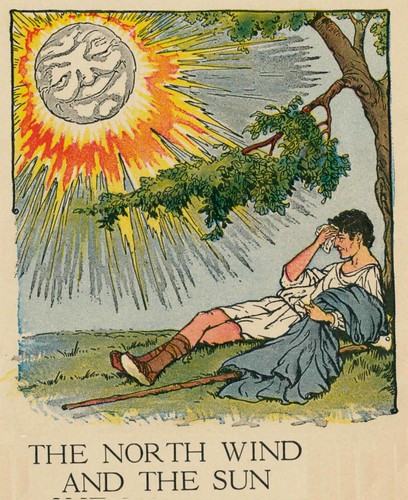
My dear friends, some of us may remember the story of the argument between the Wind and the Sun. To find out which of them was more powerful, they each took turns to persuade a passerby to take off his coat. Despite blowing with all its might, the Wind only managed to make the poor guy cling more tightly to his garment. Whereas the gentle yet persistent rays of the Sun eventually convinced him to change his mind.


Although we may not often notice it, in our liturgy for Good Friday, we find a similar contrast between two different forms of power: the power of God, and that of the world. For the first reading poses this question to us: to whom has the power of the Lord been revealed? And, in the gospel, Pontius Pilate says to Jesus: Surely you know I have power to release you and I have power to crucify you?


As fearsome and terrifying as Pilate’s power may be, it is not difficult to discover its limits. For not only is Pilate driven by fear to act against his own better judgment, he is also manipulated by those he is supposed to govern. Nor is it just Pilate who experiences the limits of worldly power. Peter does too. As when he rashly draws his sword to maim a fellow human being, only to cowardly deny Jesus later on. Thankfully, the rooster’s cry brings our first pope to his senses. Awakening him perhaps to the irony in his threefold denial. For it is true that Peter does not yet know the Lord. Since his own ego-driven and prideful path runs counter to the humble Spirit-led way of his Master.


The gospel also makes it very clear that Jesus too is powerful, even as he submits to suffering. Why else do his captors fall to the ground? But the Lord’s power is very different from the world’s. Not only does it look different, it also produces different effects. Worldly power leads to the breaking of bodies and relationships. Godly power builds up both. Isn’t this what we see when, at the foot of the Cross, the beloved disciple makes a place in his home for Mary? Or when, after Jesus’ death, both Joseph of Arimathea and Nicodemus finally manage to overcome their fear, and publicly admit to being followers of the Lord?


My dear friends, in a few moments, we will all be invited to kneel and to adore the Cross of Christ. Why, if not because we recognise in it the sign of godly power, and the source of eternal salvation? Gazing upon the Cross in faith, and recalling the Lord’s sacrifice for us with gratitude, we experience the face of God shining upon us, melting and mending our often cold and tired, lonely and broken hearts. Isn’t this what we all need especially now? After a long year, labouring under the power of a pandemic? Or perhaps after a weary lifetime of being misled by the deceptive promises of the world?


Sisters and brothers, like the gentle yet persistent rays of the Sun, in the Cross of Christ, the merciful love of God smiles down upon us all. How shall we submit more fully and generously to its transforming power today?

Sunday, March 28, 2021

Tapping-Out Vs Diving-In


Palm Sunday of the Lord’s Passion (B)

Readings: Isaiah 50:4-7; Psalm 21(22):8-9,17-20,23-24; Philippians 2:6-11; Mark 15:1-39

Pictures: cc James Brooks & FeBird Hou


My dear friends, are you familiar with the term tap-out. In certain martial arts contests, when one fighter is unable to break free from an opponent’s grip, he or she taps the opponent to concede defeat. Tapping-out is a sign of submission, of surrender, of withdrawal, of giving up the fight. Do you ever feel like doing that? Like you’ve simply had enough, and are ready to quit? What do you do? Where or how do you find the strength to soldier on?


These are some of the questions that come to mind at the start of Holy Week, as we watch Jesus take the painful road that leads from the palms of welcome to the passion of betrayal and rejection, of torture and death. There is a word that appears both in the prayer we said at the beginning of Mass, and in the blessing we will use at the end. A word that describes this road that Jesus walks. The word is submit. The road to the Cross is a journey of submission.


And yet it’s important that we understand what this means. Unlike a martial arts contest, the Lord’s submission is not a giving up, or a withdrawal. On the contrary, it is a total dedication of oneself. In the first reading, the suffering servant devotes every part of his body to the mission entrusted to him. I offered my back to those who struck me, my cheeks to those who tore at my beard; I did not cover my face against insult and spittle. And the second reading beautifully describes how Christ empties himself, even to the point of accepting death, death on a cross. The submission of Christ is not a tapping-out but a diving-in. An ever deeper immersion into the messiness and pain of human reality.


And the readings also indicate to us how Jesus finds the strength to do this. The resources on which he draws. When it seems as though the prospect of the Cross is too terrible for him to bear, Jesus gathers his disciples for spiritual conversation and shared prayer. And when even these closest friends of his fail him, the Lord prays earnestly and honestly to his heavenly Father. Not just in the Garden of Gethsemane, but also on the Wood of the Cross. By taking pains to maintain connections, both with supportive friends, and ultimately with his faithful God, Jesus is able to tap into the energy he needs to sustain his submission to suffering.


As a result, the Lord himself becomes a resource for all who may be tired or burnt out from fighting the good fight. Jesus is that loving, consoling, re-energising Word, spoken by God to all who are wearied. Allowing us to share the experience of the centurion at the foot of the Cross. Able to somehow recognise the encouraging presence and action of God, even in the most depressing of situations.


Especially when we are tired and tempted to tap-out, it’s important to remember that the Lord’s journey to the Cross is for us a reliable wellspring of sustainable energy. Sisters and brothers, what must we do to better tap into this spiritual resource, so as to engage ever more deeply and lovingly in our beautiful but chaotic world today?

Sunday, March 21, 2021

Pictures of Power


5th Sunday of Lent (B)
My dear friends, I expect that many, if not all, of us have seen the striking image that went viral some days ago. The one where a Catholic nun kneels before a group of armed riot police, and begs them not to fire on the protesters behind her. Reports say Sr Ann Rose even asked the police to kill her instead. If you have seen the image, did you notice how it was able to tug at the heartstrings in such powerful ways? Indeed, Sr Ann Rose said that she did what she did because she herself was moved by the sight of the suffering people.

The power of images to move human hearts. This is also what we find in our readings today. In the gospel, when Jesus hears that some Greeks want to see him, he responds neither by agreeing nor disagreeing. Instead he starts to talk about how his hour has come, when he will be glorified. Although he doesn’t say it explicitly, we the readers are expected to know that Jesus is talking about his coming crucifixion. That is the image he paints for us. And, like that kneeling nun, the image of the crucified Lord holds tremendous power.

Power to do what? First of all, the readings tell us that it has the power of reconciliation. The power to mend broken bonds, and to establish new ones. Isn’t this what Jesus means when he says a grain of wheat that falls and dies bears much fruit? Or when he promises that, once he's lifted up, he will draw all to himself? How does this happen, if not through the power of an image to move the heart? Isn’t this how God fulfils the promise made in the first reading? To write a new covenant on the hearts of the people.

Second, the image of the crucified Christ also has the power of rejuvenation. As the second reading tells us, through his suffering, Jesus became for all who obey him the source of eternal salvation. To all who are open enough to receive it, the crucifixion brings new life, fresh sustainable energy. And it does this by answering the plea we made in the psalm. By purifying our hearts. Freeing them from all that corrupts them.

Third, in addition to reconciliation and rejuvenation, the image of the crucified Christ also bestows the power of recognition. For although Jesus died once for all, more than two thousand years ago, there remain many in our world today who continue to be crucified, or oppressed, in some way. Not just by unjust political forces. But also by cruel social prejudices. Or harsh economic pressures. Or even unrealistic familial and societal expectations. Such as the ones that so many of our children have to struggle to meet everyday.

Reconciliation, rejuvenation and recognition. These are among the powerful effects that the crucified Christ can have on us. Effects that we are better able to experience, the more intently we ponder his image. The more conscientiously we recall and celebrate his story. The more earnestly we commit ourselves to follow in his footsteps. Isn’t this what Lent is for?

Sisters and brothers, like Sr Ann Rose, the kneeling nun, what shall we do to allow the image of the crucified Christ in his suffering people to move us ever more powerfully today?

Sunday, February 21, 2021

Receiving Revelation


1st Sunday of Lent (B)


Readings: Genesis 9:8-15; Psalm 24(25):4-6,7b-9; 1 Peter 3:18-22; Mark 1:12-15

Picture: cc Hafiz Issadeen


My dear friends, have you ever gone for an X-ray or a scan of some kind? As you know, scans uncover things that would otherwise remain hidden. And we use them not just out of curiosity. Scans play an important role both in diagnosis and prescription. Not only do they reveal hidden things, they also suggest the actions needed to address them.


Revealing hidden things in order to prompt needed action. This is also what our readings do for us today. Although, at first glance, the flood in the first reading may seem like nothing more than a punishment sent by God, it also functions as a spiritual scan. For before being swept away physically, by the raging waters of the flood, sinful humanity was already drowning spiritually, in its own violence and cruelty. The physical event uncovers the spiritual reality.


But the flood doesn’t just reveal the deadly consequences of sin, it also indicates a way out. We see this especially in the Covenant that God makes, not just with Noah, but with every living creature… for all generations. What this reveals to us is God’s desire not to destroy the wicked, but for the wicked to turn back and live (see Ez 33:11). Repentance wins salvation.


Which is also the Good News that Jesus proclaims in the gospel. But first the Lord allows himself to be driven by the Spirit into the wilderness. Like the waters of the flood, the wilderness also functions like a scan. It reveals the otherwise hidden spiritual experiences of the Lord. Much as, in his public ministry, Jesus displays mastery over diseases and demons alike, what the wilderness shows us is that this mastery comes through a constant struggle against Satan. A struggle that the Lord always wins, because he draws power from the One who sends angels to look after him.


And the second reading reminds us of the full extent of Christ’s victorious struggle. In the body he was put to death, in the spirit he was raised to life… Here is revealed the deeper significance of his Dying and Rising, into which we have all been baptised. If only we keep struggling in the Lord, we too will enjoy the benefits of the Covenant. We too will find life.


Revealing hidden things in order to prompt needed action. This is really what the season of Lent is all about. More than just a time for giving up desserts, Lent is meant to function like a scan. It reveals hidden things to prompt needed action. Consider the opening prayer we offered earlier. We asked that through the yearly observances of holy Lent… we may grow in understanding of the riches hidden in Christ (revelation) and by worthy conduct (action) pursue their effects


Perhaps this is the deeper reason why some Catholics feel as if 2020 was a year-long experience of Lent. Not just because it was so difficult and trying, but also because it reveals to us hidden things about ourselves and our world. Indicating to us what we need to do to repent and to find fullness of life.


Sisters and brothers, if Lent is truly a spiritual scan, then what must we do to better submit to its consoling discipline today?