Sunday, March 26, 2023

Of Places & People


5th Sunday of Lent (A)


Readings: Ezekiel 37:12-14; Psalm 129 (130); Romans 8:8-11; John 11:1-45

Video: TODAYonline on YouTube


My dear friends, do you recall that flaming-red HDB lift lobby in Tampines, which went viral some weeks ago? Initially, residents complained that it was too creepy, and the authorities responded by repainting the ceiling white. But then some others were actually attracted to the place, and started using it for fashion shoots. From an eery haunted house to a stylish photography studio. Isn’t it interesting how a place can seem so different when the people are changed?


In our scriptures too, we find places being transformed through a change in people. The promise God makes in the first reading comes at the end of a vision received by the prophet Ezekiel. He sees a scary place. A valley filled with dry human bones. An abandoned battlefield where, as an act of humiliation, the dead bodies of the losers had been left to rot in the sun. But then breath enters the bones. The corpses are given new life. The place undergoes a radical transformation, from humiliating graveyard to rejuvenating spa. And God goes on to explain that this vision is less about the dead than it is about the living. The broken remnants of God’s people, living in exile. God promises to raise them from their metaphorical graves, and to resettle them in their homeland. How? By first putting God’s spirit in them. By changing them into a holy place, a faithful temple, a true house of God.


In the gospel, a cave used as a tomb becomes a womb, from which a corpse is brought back to life. And this transformation of place is again effected by a change in people. A process involving several steps. First, there is a delay. Jesus waits till his dear friend has died, before visiting. And even after he arrives, instead of heading directly to the tomb, the Lord hangs back and engages people in dialogue. The delay allows mourning. The dialogue deepens trust. All of which serve to heighten receptivity to the Spirit, to awaken faith. I am the resurrection and the life… Do you believe this? Eventually a gracious invitation is extended: Where have you put him? Lord, come and see… So the Lord goes. He draws near. And through the power of his presence, coupled with the fervour of their faith, death gives way to new life.


Delay, dialogue and drawing near. Isn’t this also how we hope to be changed in Lent? A time when we prepare to faithfully accompany the Lord who, through his Dying and Rising, keeps drawing near. We hope to undergo that same life-giving change, which he effected in his friends at Bethany. Allowing the Spirit of Christ to dwell in us and to possess us. So that he who raised Jesus from the dead (might) give life to (our) own mortal bodies through his Spirit living in (us). And this change in us is not just for us. It is also so that this conflict-ridden disaster-prone world of ours, including our society and Church, our schools and homes and workplaces, might all be transformed into the Kingdom of God.


Sisters and brothers, much as we may sometimes have to change places to appease people, how shall we let God transform the world, by first effecting changes in us this Lent?

Sunday, March 19, 2023

Between Condition & Choice


4th Sunday of Lent (A)


Readings: 1 Samuel 16:1, 6-7, 10-13; Psalm 22 (23); Ephesians 5:8-14; John 9:1-41

Video: Movie Buff Guy on YouTube


My dear friends, which do you think is worse? To be blind in one eye or in both? The answer seems obvious, right? And yet we also know that to close one eye is to look the other way. To ignore something we know to be true. Perhaps a mistake or a misdeed of some sort. Whether it’s because we want to give someone a second chance, or due to laziness or apathy, fear or favour, whatever the reason, to close one eye is to remain blind by choice. And this is one of the two different kinds of blindness we find in our scriptures today.


But let us consider the other kind first. We may call it blindness as a condition. One example is that unnamed man in the gospel, who was blind in both eyes. A condition he did not choose. He was born that way. But when the Lord tells him what he must do to be healed, he obeys without hesitation. As a result, he eventually receives not just his sight, but also the grace to recognise, worship and follow Jesus as Lord. Through humble obedience, a physical disability becomes a channel of great spiritual blessing.


But blindness is not just a physical condition, right? It is often also a social one. Why does Samuel want to anoint Jesse’s eldest son? Isn’t it because the prophet is socially conditioned to be blinded by Eliab’s imposing physique? Such that Samuel is unable, at least initially, to adopt God’s perspective. For the Lord does not see as mortals see; they look on the outward appearance, but the Lord looks on the heart (NRSV). Thankfully, again through humble obedience, Samuel overcomes his social conditioning. The prophet receives new spiritual sight, and the nation its rightful king.


Unfortunately, the same cannot be said about the other characters in the gospel. Unlike Samuel, the blind man’s neighbours, his parents, and the religious leaders all fail to get past their social conditioning. Though faced with the undeniable fact of the blind man’s healing, they still lack the honesty and humility to accept Jesus as Lord. The neighbours may be too distracted by the busyness of daily life. The parents are too fearful of being expelled from the synagogue. The leaders are too attached to their own status. Whatever the reason, they all end up closing one eye to the truth. And their blindness gets worse. It progresses beyond a received condition, to a guilty personal choice.


It’s clear then that what our scriptures offer us today is at once a joyful promise and a sobering warning. The promise is that the Lord can and wants to help us transcend our conditioning, to give us new spiritual sight. And the warning is that the choice remains ours to make. Whether to be like children of light… having nothing to do with the futile works of darkness but exposing them by contrast, or to keep ignoring the Lord’s illuminating presence and action in our daily lives.


Sisters and brothers, strange as it may sound, in the spiritual life, it's probably far more dangerous to be blind in one eye than in both. What must we do to let the Lord open both our eyes this Lent?

Sunday, March 05, 2023

Remembering To Run The Race


2nd Sunday of Lent (A)


Readings: Genesis 12: 1-4; Psalm 32 (33): 4-5,18-20, 22; 2 Timothy 1: 8-10; Matthew 17:1-9

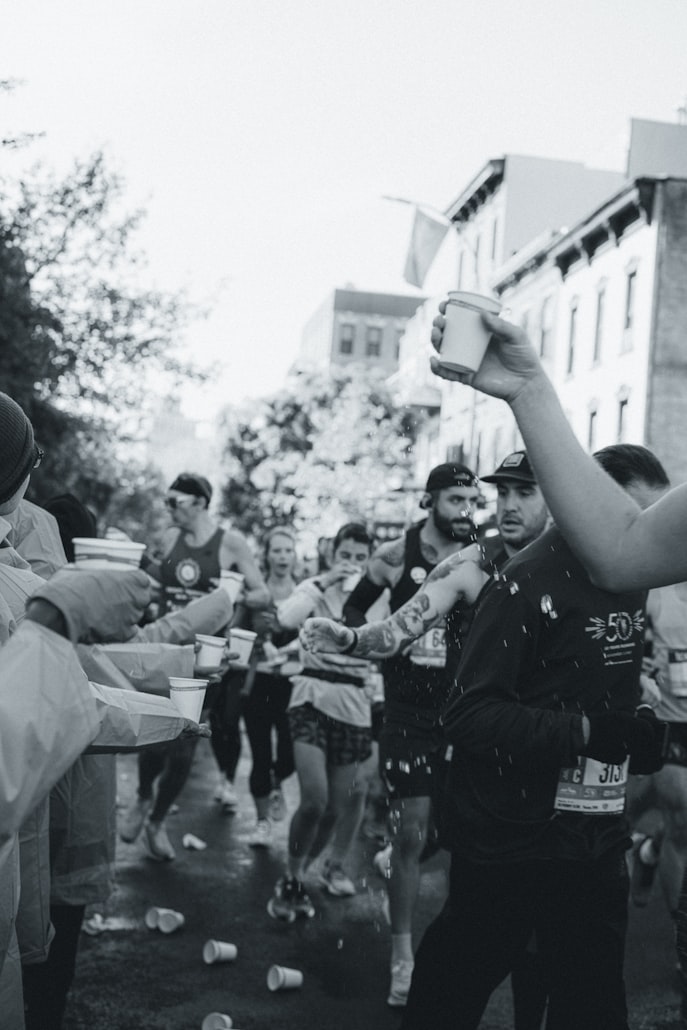
Picture: David Utt on Unsplash


My dear friends, have you ever noticed how, in marathons and other long-distance road races, water stations are set up all along the route? These provide not just drinks, but sometimes also food. What do you think will happen if, out of the blue, a passerby were to walk up to such a station and start helping himself to the refreshments? Very likely, he’ll gently be told that they are only for those running the race.


This close connection between sustenance provided and a race to be run is central to the Transfiguration. In the gospel, the reason why Jesus leads Peter, James and John up a high mountain is to encourage and energise them. To provide them with the sustenance they need to keep following him. On the mountain, not only are they shown the Lord in his glory, they are also given assurance that Jesus is indeed the fulfilment of God’s promises in the scriptures. Even more, they are given a further unspoken promise that they will share the Lord’s glory, if only they listen to him.


But listen to him say what? To answer this question, we need to consider what happens in the gospel both before and after the Transfiguration. We need to recall that, before going up the mountain, Jesus had led his disciples to a place called Caesarea Philippi, where he asks them, who do you say that I am? (16:15). After which, he reveals to them, for the first time, that he must go to Jerusalem… undergo great suffering… be killed, and on the third day be raised (16:21). He also tells them that those who want to be his followers, must deny themselves and take up their cross and follow him (16:24). Then, after coming down the mountain, Jesus tells them a second time that he is going to be betrayed into human hands, and they will kill him, and on the third day he will be raised (17:22-23). So the experiences on the mountain are meant to help the disciples follow Jesus to Calvary.


This close connection between a sustaining promise of glory and a challenging call to discipleship is central not just to the Transfiguration. We find it in the other readings as well. God’s promise to make Abram a great nation is offered to spur him to obey the call to leave home for an undisclosed destination. And the power of God’s grace revealed in Christ is what gives Timothy the strength to answer Paul’s call to join him in bearing hardships for the sake of the Good News.


Just as the water stations in a marathon are for those who run the race, the consolations of the Transfiguration are for those who follow Christ to the Cross. And we experience this close connection not just at extraordinary moments, such as while on retreat, but also ordinarily, every time we gather for the Eucharist. But to appreciate the connection, to enjoy the sustenance, we need to keep following the Lord. Otherwise, how not to feel bored and distracted at Mass?


Sisters and brothers, the water stations are meant for those who run the race. In this season of Lent, what must we do to better enjoy the sustenance the Lord provides us, so as to bravely take up our cross everyday and follow him?

Sunday, February 26, 2023

Places, Pathways & Presences


1st Sunday of Lent (A)


Readings: Genesis 2: 7-9, 3: 1-7; Psalm 50 (51): 3-6, 12-14, 17; Romans 5: 12-19; Matthew 4:1-11

Pictures: Carlita Benazito & Ronan Furuta on Unsplash


My dear friends, what is the difference between care and control? I imagine that the parents of teenage children probably know best, from experience, what it’s like to grapple with this distinction. That although care and control can sometimes look very similar, they are actually as different as night and day. Our scriptures portray this difference in a particularly striking way, by presenting us with two contrasting places: the garden and the wilderness.


In the first reading, we’re told that, at the dawn of creation, God planted a garden, where God put the man he had fashioned. What makes this place a garden is the fact that it is cared for by God. And the reason God puts the man in the garden is so that he too can cultivate and take care of it (Gn 2:15 [JB]). But this plan is disrupted, and it’s important to see how this happens. What is the nature of the temptation to which the man and the woman succumb? What is so attractive about being like gods? After all, aren’t they already created in the image of God (Gn 1:27)? Don’t they already share in God’s work of caring for creation? Yet, for some mysterious reason, they’re not satisfied just to receive and to offer care. They want control. And as they worship the idol of control, their home is tragically changed into a wilderness.


In the gospel, at the dawn of his public ministry, the Word-of-God-Made-Flesh is led by the Spirit out into the wilderness to be tempted by the devil. And again it’s helpful to ponder the nature of these temptations. Notice how they are ever more obvious ways of seeking or flaunting control, culminating in a blatant demand for idolatrous worship. And notice also how, after Jesus dismisses the devil, angels appeared and looked after him. By his obedience, Jesus changes his surroundings from a wilderness of control, back into a garden of care.


So that, as the second reading reminds us, both Adam and Jesus offer us separate pathways from which to choose. Each leading to a different destination. Adam’s craving for control, leading to disobedience and sin, idolatry and banishment, versus Jesus’ exercise of care, leading to obedience and grace, right worship and closeness to God. And more than just external pathways, Adam and Jesus are also interior presences, or powers, that we each experience in our hearts and in our lives. One relentlessly driving us to cling anxiously to control. The other gently inviting us to trust, to submit and to share in the loving care of a merciful God.


All of which helps us to better understand the deeper meaning of this holy season of Lent. By entering together the wilderness of prayer, fasting and almsgiving, we seek to see more clearly, and to choose more wisely the places in which to live, the pathways along which to walk, and the presences from which to draw strength.


Sisters and brothers, how does God wish to transform our wildernesses of control back into gardens of care this Lent?

Sunday, February 19, 2023

The Transformation of Pain

7th Sunday in Ordinary Time (A)


Readings: Leviticus 19: 1-2,17-18; Psalm 102 (103): 1-4, 8, 10, 12-13; 1 Corinthians 3: 16-23; Matthew 5: 38-48

Video: Spencer Nelson on YouTube


My dear friends, have you ever noticed how pain can become a prison? We’ve all experienced pain in one form or another. And we know, at least in theory, that it has a useful purpose. It draws our attention to what needs to be addressed. Like how a toothache is often a sign of a cavity. And yet pain can also hold us so tightly in its grip that we cannot escape. We fixate on the hurt we’ve suffered, and the one who may have caused it. We may even be driven to retaliate. To make the perpetrator suffer, as we have suffered. But retaliation only begets further retaliation, and the resulting cycle of violence becomes yet another prison. How then to break free?


The scriptures offer us a path in three steps. They widen our perspective, deepen our purpose, and propose to us a person. First, even as pain tends to narrow my vision, forcing me to focus only on myself, the readings offer a broader view. They invite me to look beyond what I suffer, to who God is, and what God does. They remind me that God is holy, and that God’s holiness is shown in God’s undying compassion and steadfast love toward me, even though I don’t deserve it. For he does not treat us according to our sins nor repay us according to our faults, but causes his sun to rise on bad… as well as good, and his rain to fall on honest and dishonest… alike.


Next, the readings also remind me that there is a deeper reason for my existence, beyond merely enjoying pleasure and avoiding pain. That by my baptism, I have become part of a people, called to be holy as God is holy. Called to be nothing less than the embodiment, in the world, of God’s mercy and compassion. So that, through us, all of creation may be set free. Didn’t you realise that you were God’s temple and that the Spirit of God was living among you?


And if, due to my own weakness and sinfulness, I find this call far too daunting, the readings reassure me that that’s to be expected. For the wisdom of this world is foolishness to God, and there is nothing to boast about in anything human. Instead, to fulfil this call, I need to let my attention shift away from myself to Someone Else. To the One who resisted evil to the point of sacrificing his life on the Cross, and who, even now, remains generously and humbly present to us in this Eucharist that we are gathered here to celebrate. A powerful reminder that we belong to Christ and Christ belongs to God.


Some of us here may still recall the biographical film, Gandhi, from back in the 1980s. In one particularly memorable scene, row after row of unarmed mostly Hindu and Muslim men, calmly and willingly submit to being savagely beaten by guards carrying cruel sticks. Inspired by the one they called Mahatma, or great soul, they turned the other cheek, in order to stand for truth and justice. As a result, the prison of their pain was transformed into a pathway toward national independence.


Sisters and brothers, what must we do to let the Crucified and Risen One transform our pain, and set us all on the path of true freedom today?